Showing posts with label Swinney Park. Show all posts

Wednesday, April 16, 2014

Fort Wayne's Worst Train Wreck


by Nancy McCammon-Hansen

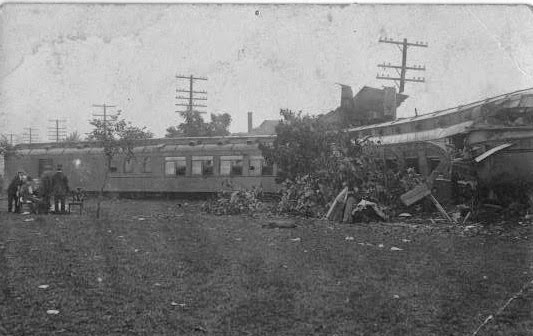
There’s nothing like an accident to bring out the gawkers and that certainly was true when Fort Wayne’s worst train wreck within the city limits occurred on August 13, 1911.


A speeding Pennsylvania Railroad passenger train, trying to make up for lost time, crashed into a freight train in Swinney Park. Three railroad workers were killed and 35 passengers and other crew members injured. (Some reports say four were killed and 30 injured.) The train was reportedly going about 50 miles an hour, traveling from Chicago to New York, when it left the track at a switch around 6:30 p.m. and crashed into the freight train. Two engines were pulling the passenger train and as they left the rails, they sideswiped the engine of the freight train.


“The baggage car, smoker, buffet, and two sleepers turned over in the ditch. Most of the injured were seated in the diner and smoker when the accident occurred,” according to the website www.historictornadoes.com/disasters/train-wrecks-accidents. Fortunately for the passengers, the train was composed of all-steel cars that survived the crash far better than “old-fashioned wood construction”. The engines of the passenger train were thrown down an embankment and the freight train’s engine “reared up over the trucks of the fliers (sic) engine”.


The information on the historictornadoes.com website was transcribed from The Washington Post District of Columbia 1911-08-14.

Other information in this blog post comes from Scott M. Bushnell’s book “Historic Photos of Fort Wayne”, which is for sale in our gift shop.

The photos come from postcards in the History Center’s collection.

Monday, June 10, 2013

The Beginnings of the Portage to the Wabash River


by Tom Castaldi

One of the principal reasons there is a community in Fort Wayne today is the “portage.”  Not far from our Indiana city, to the west across the river, was the eastern entrance to this important feature.

The portage, a French term for “carrying place,” denotes the route where early travelers carried their canoes from one river over to another.  At Fort Wayne the portage connects the Saint Mary’s River and the Maumee Valley to the Wabash River and the Ohio and Mississippi rivers beyond.  It is the only place where travelers by boat had to go overland when making their way from the Great Lakes to the great western rivers leading to the Gulf of Mexico.

The eastern terminus of the portage was located in today’s West Swinney Park where there were many campsites.  The portage route followed the high ground away from the St. Mary’s River, along Portage Boulevard and through the Fort Wayne County Club grounds, southwest past Fox Island Park to a site near Ellison Road in today’s Aboite Township, where the Little Wabash River begins to make its way to the Wabash.

Usually the route was about nine miles long.  Often after the spring floods, however, there would be water all the way to the Wabash; during drought the carrying distance might be as long as twenty-five miles.  The portage was well marked by paths and wagon tracks and was elaborately developed with bridges and causeways to help travelers in the crossing, although there were frequent complaints about beavers damming the Little Wabash River.

The portage made the Miami wealthy, for the tribe levied a charge on those who used it.  Even in the earliest accounts from the 1690s, the portage was referred to by the French as a “Toll Road Swamp.” Through their control of the portage, the Miami enjoyed power and prestige in the region.  They also attracted attention, first from the French and the English who sought to dominate the Indians through their influence, and then from the Americans, who sought to conquer the area and establish their own control over the vital crossroads.

The importance of the portage declined sharply with the coming of the Wabash and Erie Canal in the 1830s.  By the time of the Civil War, it was little more than a trail through the western marshes of the country; and with the great drainage projects of the 1890s, it virtually disappeared, leaving behind the community to which it gave birth.


 Originally published in Fort Wayne Magazine, “Along the Heritage Trail with Tom Castaldi” – June 2005 No 13, p. 37
 
For a map of the portage, please see:


Wednesday, June 30, 2010

The Indomitable Rhesa Swinney

One of the treasures of the History Center's collection is the daguerreotype of Rhesa Swinney (1833-1911), daughter of Thomas and Lucy (Taber) Swinney.

A note found behind the image in its case bears the date of December 25, 1851, indicating that it was probably a Christmas gift from the daughter to her parents. The identity of the photographer is not known, but it may well have been Archibald McDonald, Fort Wayne's most prolific daguerreian artist who had arrived from Buffalo the year before. The result of this Christmas sitting is one of the most exquisite portraits of the period.

There is a sense of immediacy about a daguerreotype. As the author Joan Severa observes, "Besides being the truest glimpse of a moment in the past, it is also a peek into the life and personality of a real person living in a time so different from our own. We experience inescapable emotions when viewing these images. A certain vivid face, looking out at you, with its voice just a breath from speaking, can sometimes stop your heart." (Joan L. Severa, My Likeness Taken: Daguerreian Portraits in America [2005], p. xv).

Such it is with the portrait of Rhesa, one of the most beautiful women of her time in Fort Wayne. Her life is a study of both tragedy and resilience, depicted poignantly in this image. As the daughter of a wealthy farmer, Rhesa was petite, well-educated, and enjoyed a home with some of the finest amenities of the time. Engaged to be married to J. McNutt Smith, a telegraph operator, she had her heart broken when Smith decided to elope instead at the last minute with her sister, Margaret (1834-1918), on June 27, 1858. Rhesa was so crazed with grief that she pulled out most of her hair, forcing her to wear a wig for the rest of her life. Margaret and her family were never welcomed back into the Swinney home. Ironically, just prior to the elopement, Rhesa had posed with Smith and her sister Margaret, with Smith's arm tellingly draped around his future wife. The image was later altered and the face of another sister, Caroline, glued over that of Margaret.


Rhesa rebounded after her broken heart. She never married. Instead, showing strength of character, she became the head of her family after her father's death in 1875. She managed the farm, completed construction of a commercial building near the courthouse, and enjoyed playing hostess. On New Year's Day, she presided over large teas with place settings of fine china for more than 100 guests. She was remembered for her "mincing walk, a sort of dancing step with her small feet" as she strode through the city and was unflappable when a gust of wind once blew off her wig. Her father had left the city the grounds that would become Swinney Park, yet it was Rhesa who finalized the agreement with officials in 1893. When she died in 1911, her surviving unmarried sisters said, "The best is none too good for her." She was buried in a casket that cost $1,000, and her funeral was one of the most expensive of the period.

In many ways the daguerreotype captures the spirit of the indomitable Rhesa, beautiful and untouchable, who carved for herself an independent life outside the norms of her time.