Showing posts with label Anthony Wayne. Show all posts

Tuesday, August 5, 2014

Why was Anthony Wayne “Mad”?


by Carmen Doyle

There are two different explanations.

One explanation says that the nickname started because of Wayne’s “daring valor” at the Battle of Stony Point. The success of the battle inspired the population so much that he began to be called “Mad” for his audaciousness and bravery.

That’s what Washington Irving (the author of “Rip Van Winkle” and “The Legend of Sleepy Hollow”) wrote in his “Life of Washington.” 


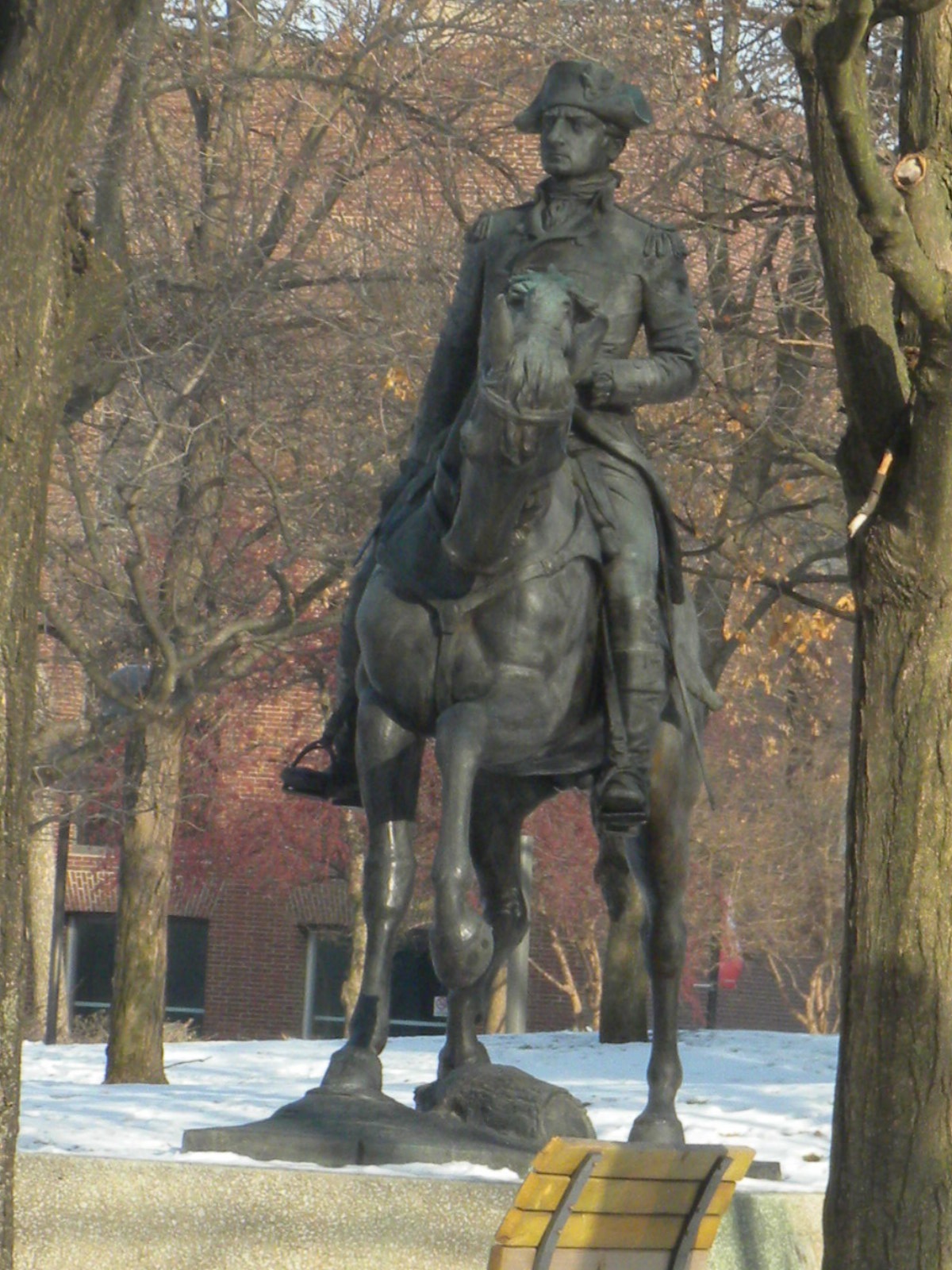
Anthony Wayne Statue in Freimann Square

Another explanation is that the nickname resulted from Wayne’s treatment of a soldier, Jemmy the Rover. Jemmy allegedly had unofficial permission to go to and from the fort as he wanted, perhaps because he occasionally worked as a spy for Wayne. 

Jemmy went missing for an unusually long period of time, and when eventually found, it was because he had been put in jail for disorderly conduct.

Jemmy tried to get General Wayne to intervene and let him out of jail, but Wayne refused. Instead, he ordered Jemmy to be given 29 lashes. Upon hearing this, Jemmy started to mutter that “Anthony is mad. He must be mad, or he would help me. Mad Anthony, that’s what he is. Mad Anthony Wayne.”

It was considered to be such a good story, as well as a fitting name, and the story was repeated often, that the name stuck, although the reason behind the nickname was only dimly remembered.

Anthony Wayne had a big impact on modern popular culture, although this is not well known. 

Marion Morrison had to change his name for the screen. Director Raul Walsh was reading a biography of Anthony Wayne, and suggested the actor change his name to Anthony Wayne. The studios liked Wayne, but thought “John” was a better first name- so Marion Morrison became John Wayne, in a tribute to the Revolutionary War hero.

Another big impact on pop culture is Anthony Wayne’s fictional descendant- Bruce Wayne. 

So John Wayne and Batman owe part of their legacy to “Mad” Anthony Wayne.

Thursday, June 26, 2014

Whistler and the Last Two American Forts at the Three Rivers


Old Fort Wayne in 1797

by Tom Castaldi

John Whistler came to America as a British soldier in the Revolution, under the command of General John Burgoyne. He was captured, paroled and sent back to England. His elopement with Anna Bishop, daughter of Sir Edward Bishop, a close friend of his father, brought the young man and woman to America where they made their first home at Hagerstown, Maryland, in 1790.

The following year, after joining the army of the United States, John Whistler came west with General St. Clair’s army. He escaped after suffering severe wounds received at the “Wabash slaughter field” handed to the Americans by Little Turtle’s warriors at Fort Recovery. Back in Cincinnati at Fort Washington Whistler returned to receive a new assignment and was joined there by his wife.

When General Anthony Wayne’s army arrived, Whistler joined them on the march into northwest Ohio where he participated in the Battle of Fallen Timbers. After defeating the Indian confederation under the leadership of the Shawnee brave Blue Jacket, on August 20, 1794, Wayne moved his “Legion of the United States” up the Maumee River to the large American Indian settlement of Kekionga at the confluence of the Three Rivers.

Wayne ordered a fort to be built in 1794 on the high ground overlooking the confluence of the Saint Mary’s and Saint Joseph rivers and the Miami town of Kekionga. In 1798, Colonel Thomas Hunt began construction of a second American fort at the Three Rivers. This fort, near present-day East Main and Clay Streets, was completed in 1800 and served as a replacement for the first hastily built one erected nearby to the south by General Wayne.

The American forts at the Three Rivers came under attack only once during nearly a quarter-of-a-century while they guarded United States interests in the midst of Indian territory. In 1815, after having withstood a siege three years earlier, this stronghold was replaced under the direction of now Major John Whistler. By 1816, Whistler, the Fort’s Commandant, was transferred to a new assignment in Saint Louis, Missouri. The fort Whistler had rebuilt during 1815 and 1816 was the last in the Three Rivers region and on April 19, 1819, was abandoned by the U. S. Army.

After the Battle of Fallen Timbers, Whistler and his wife resided in the fort at Fort Wayne, and here, in 1800, George Washington Whistler was born, one of fifteen children. George became “Whistler’s Father” the father of James Abbott McNeill Whistler whose renowned oil on canvas, “Arrangement in Grey and Black: Portrait of the Painter’s Mother”, is known to the world as “Whistler’s Mother”.

The Indian Agency continued to operate in the fort after it was decommissioned by the government and the first school in Fort Wayne was established here by the Baptist missionary, Isaac McCoy, from 1820 to 1822. The land immediately around the fort was ceded to Allen County by an act of Congress in 1830 and it wasn’t until 1852 that the last building of the fort was demolished.

Originally published in Fort Wayne Magazine “Along the Heritage Trail with Tom Castaldi” – January 2008 No. 39 Allen County Historian Tom Castaldi is author of the Wabash & Erie Canal Notebook series; hosts “On the Heritage Trail,” which is broadcast at 6:35 a.m., 8:35 a.m. and 6:30 p.m. Mondays on WBOI, 89.1 FM; and “Historia Nostra” heard on WLYV-1450 AM and WRRO 89.9 FM. Enjoy his previously published columns on the History Center’s blog, “Our Stories,” at history centerfw.blogspot.com.


Wednesday, March 13, 2013

Major General Anthony Wayne


Today we kick off a new series of blog posts by Allen County Historian and History Center board member Tom Castaldi. Through the generosity of Fort Wayne Monthly, we will be bringing to you Tom's columns originally published in the magazine under the heading "Along the Heritage Trail". This first column originally appeared in the September/October 2003 issue.

by Tom Castaldi 

 In the early 1790s, the United States Army suffered two serious defeats at the hands of American Indians under the leadership of Little Turtle, war chief of the Miami nation.  In response, President George Washington sent Revolutionary War hero Major General “Mad” Anthony Wayne into the western frontier.  He had earned the nickname “Mad” for his reckless daring in a spectacular attack on the British at Stoney Point, N.Y., during the Revolutionary War.

Anthony Wayne was born January 1, 1745, in Waynesboro, Pennsylvania, in Chester County near Philadelphia.  When the Revolutionary War erupted in 1775, Wayne was quick to join the American Army and was named colonel by the Continental Congress with the command of a Pennsylvania Regiment, which he led in the invasion of Canada in 1776.

After Valley Forge, in the spring of 1778, Wayne played a significant role at the Battle of Monmouth.  Because he frequently could be found with his men herding stolen British cattle to the Americans, he was given the derogatory nickname “Drover” Wayne by the annoyed enemy.  His own men, on the other hand, often called him “Dandy” Wayne because he was so particular about the correctness of his uniform.  Wayne continued to be active in the last years of the Revolutionary War particularly in the southern campaigns and was present at the British surrender at Yorktown.

After the war, Wayne retired to the life of a gentleman farmer in Pennsylvania where he helped draft the state’s first constitution.  Never a man to sit still for very long, Wayne became involved in a scandalous relationship with a Miss Vineing, to the extreme annoyance of his wife, Mary Penrose, and to the absolute delight of gossip-hungry circles in the eastern cities.  Such affairs did not tarnish the great general’s reputation as a soldier. He was called back into service by President Washington to lead a campaign against the American Indians of the Ohio Country in 1792 in the wake of the disastrous losses suffered by generals Harmar and St. Clair in battles against Chief Little Turtle in 1790 and 1791.

A stern disciplinarian, Wayne rigorously trained his troops before he took his “Legion of the United States” into Miami Territory in 1794.  At the site of St. Clair’s disaster three years earlier, Wayne’s men came upon the remains of hundreds of fallen men and women, now scattered about the old battlefield. Their bones were gathered up and placed in a mass tomb, and another fort – Fort Recovery - was built.  In the midst of the construction the Indians under the leadership of Shawnee brave Blue Jacket attacked, but after a sharp battle on July 2, 1794, the natives retreated toward the Maumee River to the north. Wayne’s forces then pursued the Indians and built Fort Defiance before meeting and again defeating Blue Jacket, this time at the battle of Fallen Timbers on August 20, 1794.

Wayne next moved his “Legion” up the Maumee River to the large American Indian settlement of Kekionga, at the confluence of three rivers.  He chose a site across the Maumee River from Kekionga to build the first American fort and then handed over command to Colonel John Hamtramck.  On October 22, 1794, the fourth anniversary of the defeat of the United States at the Battle of Kekionga, Hamtramck called together a parade of the garrison, fired 15 rounds of cannon (in honor of each of the 15 states of the Union), and formally announced that this place was hence forth to be called Fort Wayne.

Anthony Wayne left Fort Wayne four days later, never to return.  After inspecting other U.S. garrisons and successfully negotiating the Treaty of Greenville with the American Indians in the region in 1795, Wayne returned to Erie, Penn., where he died in 1796.

Thursday, July 12, 2012

The Man Little Turtle


In the Old Fort News, Volume 21, Issue 3, published in 1958, Rex Potterf offered an article about Chief Little Turtle. As we head toward the anniversary of Little Turtle’s death, here are offered some words from that article. (Words in parentheses are for clarity for the reader.)

“General Washington saw him (Little Turtle) as a very good friend; he presented him with a sword…..General Washington also presented Little Turtle with a medallion; its obverse bore a picture of General Washington and its reverse a likeness of Little Turtle.

“During the weeks which Little Turtle spent in Philadelphia (1796-97 as a house guest of Washington), he saw everything that could possibly interest him. He became familiar with urban merchandising and craftsmanship, which caused him to have an increasing respect for the white man. His observation of these skills and procedures, however, caused him to feel that the white man’s civilization was not for the Indians.”

Potterf describes Little Turtle as having the “mentality of a genius” but no formal schooling and thus knowledge acquired by the experience of living the life of an Indian. He also “manifested many strange inconsistencies in his convictions and his conduct.”

Little Turtle did not believe individual Indians or tribes could cede land to the American government and that any treaty made with the United States by a tribe was not binding on other tribes. But he did sign the Treaty of Greenville in 1795 and said he would never break it.

“He also believed that whenever Indians took up white man’s ways they weakened and enervated themselves; he felt that the manners and customs of the whites which the Indians had adopted and accepted were responsible for their downfall….” But in his later years Little Turtle "rapidly assimilated the elegant manners of civilization. His manner of eating was that of the white man, as were likewise his carriage, his garments, and his food.”

Potterf described Little Turtle as a Chief of the Miami in this manner:

“The Miami Indians had two kinds of chiefs—civil chiefs, who were often hereditary, and war chiefs, who were selected by popular vote. These latter leaders were always selected on the basis of their merit. Little Turtle became the leading war chief of the Miamis. Not only was he the leading war chief of the Miamis, but the surrounding tribes, such as the Piankeshaws and Weas, looked to him for military guidance, leadership, and counsel.”

Little Turtle achieved a number of victories over American forces led by Harmar and St. Clair and raiders led by LaBalme. Little Turtle had definite skill in strategy as is evidenced by these words:

“With rather great confidence in the outcome, Little Turtle approached his problem. He first assembled the Indians,  (“having personally visited many neighboring tribes and sent emissaries into Wisconsin and Illinois”) who had come from different quarters, on a plateau along the St. Mary’s River some ten miles southeast of present-day Fort Wayne. He divided his men into several different groups or messes. He designated one fourth of these messes to hunt for game or vegetables; they were to assemble the food in the late afternoon, when the Indians were to be fed these provisions. He thus employed a very practical method of living off the country…..”

Little Turtle’s defeat of St. Clair’s forces “was unparalleled in the past, and never at any time since has the American army suffered so relatively serious a defeat. The nearest comparable defeat was the destruction of the American fleet at Pearl Harbor in 1941….”

One might say the battle appears to have changed Little Turtle as a man and a warrior.

“…..The terrible slaughter sickened him. When he realized that the whites could not possibly retrieve their defeat, he ordered his men to cease fighting and stop pursuit of the Americans. Historians have often wondered why he did not follow up his defeat and utterly destroy the American forces…..Little Turtle saw all the bloodshed on that day he ever wanted to see….Almost fifteen hundred American soldiers who survived that day owed their lives to the fact that Little Turtle ordered his men to stop the slaughter.”

Potterf says that Little Turtle “was far ahead of his time in his attitude toward war….About 1791, when he was still only forty-three or forty-four years of age, as we have seen, he came to the conclusion that war was not the way to settle difficulties. He thought wars were unproductive and should be avoided at all costs….”

But Little Turtle also knew that the Indians were no match for Gen. Anthony Wayne’s forces. “He foresaw that Indian victories over the Americans were at an end and that in the future the Indians had little hope of defeating them. Little Turtle now became an appeaser and an advocate for peace….This policy of cultivating the Americans was very distasteful to Little Turtle’s friends and neighbors. They soon regarded him as a traitor or worse….”

Little Turtle’s stance in relation to fighting Wayne was not popular, to say the least, and led to his fellow warriors turning against him.

“Little Turtle had been the chief war leader of the Miamis for fourteen years; he had led them since that night when he slew LaBalme and his eighty soldiers down on the Aboite River. His tribesmen now repudiated him; they stripped him of all military authority. Now he was only one more Indian warrior. Little Turtle’s courage had been impugned—the worse humiliation a warrior can suffer. He resolved to go into battle the next day and fight with every ounce of his strength. Always an able warrior, he fought like a tiger on that fatal day, but the Indians were defeated. Wayne vindicated Little Turtle’s judgment.”


Thursday, July 5, 2012

Remembering Little Turtle


During this week of July 4, we remember the founding of our country and the people who founded our nation. But 10 days from Independence Day we will be reflecting upon an early resident of our area—Chief Little Turtle. In Volume II, Issue No. 1 of the Old Fort News, published in March1937, editor Willis Richardson and other writers took a look at this historical figure. We publish here excerpts from that article.

“Little Turtle, Traditional and Historical”

“Much of the information concerning Little Turtle is traditional to such an extent that it becomes almost mythical. The exact date of his birth cannot be definitely determined. The places he lived, the expeditions he made, the attacks he led, and many other items of that nature are indefinite because there were no written records kept. We get the best knowledge of Little Turtle and his characteristics after the establishment of the Federal government. The official reports from the campaigns of Harmar, St. Clair, and Wayne contain accounts of Little Turtle. From the historical point of view his life may be divided into the following divisions: (1) Period before 1789, (2) 1789 to the treaty of Greenville in 1795, and (3) his retired life at Ft. Wayne from 1795 to 1812.”

You may see “portraits” of Little Turtle at the History Center and in books and other publications, but the only known official portrait was painted by Gilbert Stuart at the request of President George Washington. It is believed that no copies of the painting were ever made and the original was destroyed in 1814 when the British burned Washington, D.C. John Collias painted what some call a reproduction of the Stuart portrait but this, at the time of the writing of the original article, had not been confirmed. We do know, however, that Little Turtle wore a “necklace” made of bear claws.

John A. M. Lung described Little Turtle’s appearance in “Western Adventure”, published in 1836 at Dayton, OH:

“The leader of the Indian army at the time of St. Clair’s defeat was a chief of the Missassago tribe known by the name of Little Turtle. Notwithstanding his name he was at least six feet tall. His aspect was harsh, sour and forbidding, and his person during the action was arrayed in the very extremity of Indian finery, having at least twenty dollars worth of silver descending from his nose and ears.”

Samuel C. Drake in “Aboriginal Races of North America”, published in 1838, described Little Turtle as “six feet high, of a very sour and morose countenance and apparently very crafty and subtle.”


“Me-She-Kin-No-Quah (Little Turtle)
by Otho Winger”

“Little Turtle was the greatest of all Miami chiefs. In the estimation of many writers, he was the greatest chief of all the American Indians. He was a native of the present state of Indiana. Some day we will recognize him as our first great Hoosier and an American of National Importance.

“Little Turtle was born at his father’s village on Eel River in 1751. While there has been some question as to where this village was located, the author accepts the findings of S.P. Kaler and others who made a careful study and located it on the main branch off Eel River, five miles east of Columbia City. Aquenackque, father of Little Turtle, was a chief of great renown at this village years before his more illustrious son was born.”

Little Turtle became a hero of the Miami and its acknowledged tribal leader when he and the other men of the tribe surrounded and massacred the forces of the adventurer LaBaume, who was in the area of Kekionga—now Fort Wayne—taking possession of furs that the Native Americans had acquired.

After this event, Little Turtle spent much of his time at Kekionga, alarmed that the “white man” was coming into Kentucky and territory along the Ohio. LaBaume had traveled up the Wabash from Vincennes to this area.

Seeing that the “lands of his fathers” were being taken over by the “white man”, Little Turtle led yearly expeditions against pioneer settlements along the Ohio. This was the only method he knew to hang onto what he felt to be the property of his people.

“When Washington became president, one of his greatest problems was how to protect the frontier settlements against these Indians of the North West. In 1790, he sent Gen. Hamar with an army to capture Kekionga, but Little Turtle defeated two sections of this army and made the whole expedition a failure. In 1791 President Washington sent Gen. Arthur St. Clair with the largest army ever sent to fight the Indians. Again Little Turtle, at the head of the warriors of the North West, completely routed St. Clair and massacred most of the army at what is now Ft. Recovery, Ohio.

“After this series of defeats at the hands of Little Turtle, many Americans were willing that the Indians should retain the Northwest Territory.  President Washington was not willing for he saw that if the Indians kept it, Great Britain would soon have possession and annex it to Canada. Washington had great difficulty to get congress to vote men and supplies for another army. When he secured these he appointed Gen. Anthony Wayne as leader. The result was bound to be different from previous expeditions. Little Turtle himself advised the Indians to make peace for, he said, ‘The Americans now have a general who never sleeps.’”

Wayne made great preparations for the coming battles and with militarily sound maneuvers, defeated the Indians at Fallen Timbers, OH on August 20, 1794. The next year the Indians were forced to sign the Peace of Greenville, giving much of the North West to the United States. Fort Wayne, erected in the fall of 1794, was included in this treaty.

According to a different source, Little Turtle had urged his comrades to consider a peaceable conclusion to the fighting. From “Little Turtle’s Oration Before the Battle of Fallen Timbers”:

“We have beaten the enemy twice under separate commanders. We can not expect the same good fortune always to attend us. The Americans are now led by a chief who never sleeps; the night and the day are alike to him and during all the time that he has been marching upon our village notwithstanding the watchfulness of our young men we have never been able to surprise him. Think well of it. There is something whispers to me, it would be prudent to listen to his offers of peace.”

But the council did not accept his viewpoint and Little Turtle withdrew from active command, fighting the next day as a private warrior.

It should be noted that no authentic source for this quote could be located at the time of the writing of this article on pages 7-8, Vol. II, No. 1, OFN.

Back to Winger’s narrative:

“Little Turtle reluctantly signed the Treaty of Greenville but he declared that he would never break it. He never did. He spent the last seventeen years of his life in peace with the Americans. He already had the record of defeating more American armies than any other Indian chief. He was now to acquire the greater reputation of being most interested in ways of peace and civilization.

“With Williams Wells, his son-in-law, as interpreter, he went to Philadelphia in the spring of 1797. He called on President Washington who bestowed upon him many honors fitting a great chief. He presented him with a sword, a gun, a medal of peace and had his picture painted by the noted artist Gilbert Stuart. While in Philadelphia, Little Turtle was the guest of many leading Americans and some prominent Europeans. Among the latter was the Polish general, Kosciusko, who gave him valuable presents.”

Little Turtle went on to be a pioneer in several aspects of integrating the life of the Indians with those of the Americans. President Thomas Jefferson impressed upon Little Turtle the benefits of vaccinations. Little Turtle had himself vaccinated and brought serum back to the area for his tribe.

Because hunting as a means of making a living had ceased to be practical by this time, Little Turtle accepted money from Congress to introduce his people to farming. With help from the Quakers, he hired a teacher of agriculture and began experiments in farming on the Wabash and Eel Rivers.

Realizing the harm of liquor to his people, he became an early temperance worker, working to get state legislatures and Congress to prevent the sale of whiskey and other intoxicants to the tribes.

Little Turtle spent his later years in a government built home at the Eel River post and at the home of Wells, near Spy Run in Fort Wayne. He was mistrusted by the Indians because he maintained the peace agreement of the Treaty of Greenville and accepted favors from the government. He was viewed “as too much in favor with the white man. On the other hand his insistence on rights for the Indians caused many white men to dislike him. He opposed Tecumseh and all of his plans. So long as he lived he kept the Miamis at peace with the Americans. After the death of Little Turtle, William Henry Harrison wrote that he had shown loyalty and friendship to the United States and had rendered valuable services on many occasions.”

Little Turtle died on July 14, 1812 at Wells’ home. Although military honors were paid to him by officials and residents of Fort Wayne, no monument was erected and the exact site of his grave forgotten over time. When a grave was discovered at 634 Lawton Place in 1912, while excavation work for a new home was underway, identification of implements and trinkets in the gravesite led most to assume the grave was Little Turtle’s. The artifacts now belong to the Allen County-Fort Wayne Historical Society and many are on display in our museum. Little Turtle’s body was re-interred and properly marked and the site can now be accessed by anyone interested in this part of Fort Wayne’s history.

Otho Winger, who wrote the portion of the article quoted above, was president of Manchester College and studied Indiana Indians in general and Little Turtle in particular, leading to his being recognized as an authority on the topic. He wrote several books including “The Last of the Miamis”; “Little Turtle or Me-she-kin-no-quah” and “Frances Slocum, the Lost Sister Among the Miamis”.

You can see a number of Native American artifacts exhibited at the History Center and upon occasion at the Chief Richardville House, 5705 Blutton Road. The house is open the first Saturday of every month May-November from 1 to 4 p.m. Check our website for more information on admission charges or call 260-426-2882.

You can find many back issues of the Old Fort News on sale in our gift shop as well as books featuring Native American and area history topics. The last Saturday of July we will be part of the downtown Shopping Trolley tour and many items will be on sale for 75% off, celebrating the 75th anniversary this year of the founding of the Old Fort News.

Now’s the time to indulge your passion for history.

Monday, January 3, 2011

Who Put That There?

There’s a great little book entitled “Who Put That There” that can serve as a guide for exploring Fort Wayne’s history. The book was written by students at St. Jude Catholic School in 1998 with an Historic Preservation Grant from the Historic Landmarks Foundation of Indiana, the Indiana Humanities Council, and the National Endowment for the Humanities.


“Who Put that There: Outdoor Sculptures of Fort Wayne” is fun to look at—but it’s even more fun to actually visit the sculptures pictured in the book’s pages.


My son was visiting from NYC for Christmas and, as you well know, many of those who had left the city this year for the holiday had a challenge in returning at their appointed times. He was no exception so we had a few extra days together. Being with Mom and Dad for a week—when you’re 25 and single—doesn’t exactly make time fly so we set out one afternoon to do something besides watch television and eat.


Surprisingly enough, Chris, who has never really been “into history” but who loves art, got into the spirit as we drove around central Fort Wayne taking photos of some of the statues depicting the people who are a part of Fort Wayne’s history.


Nuckols

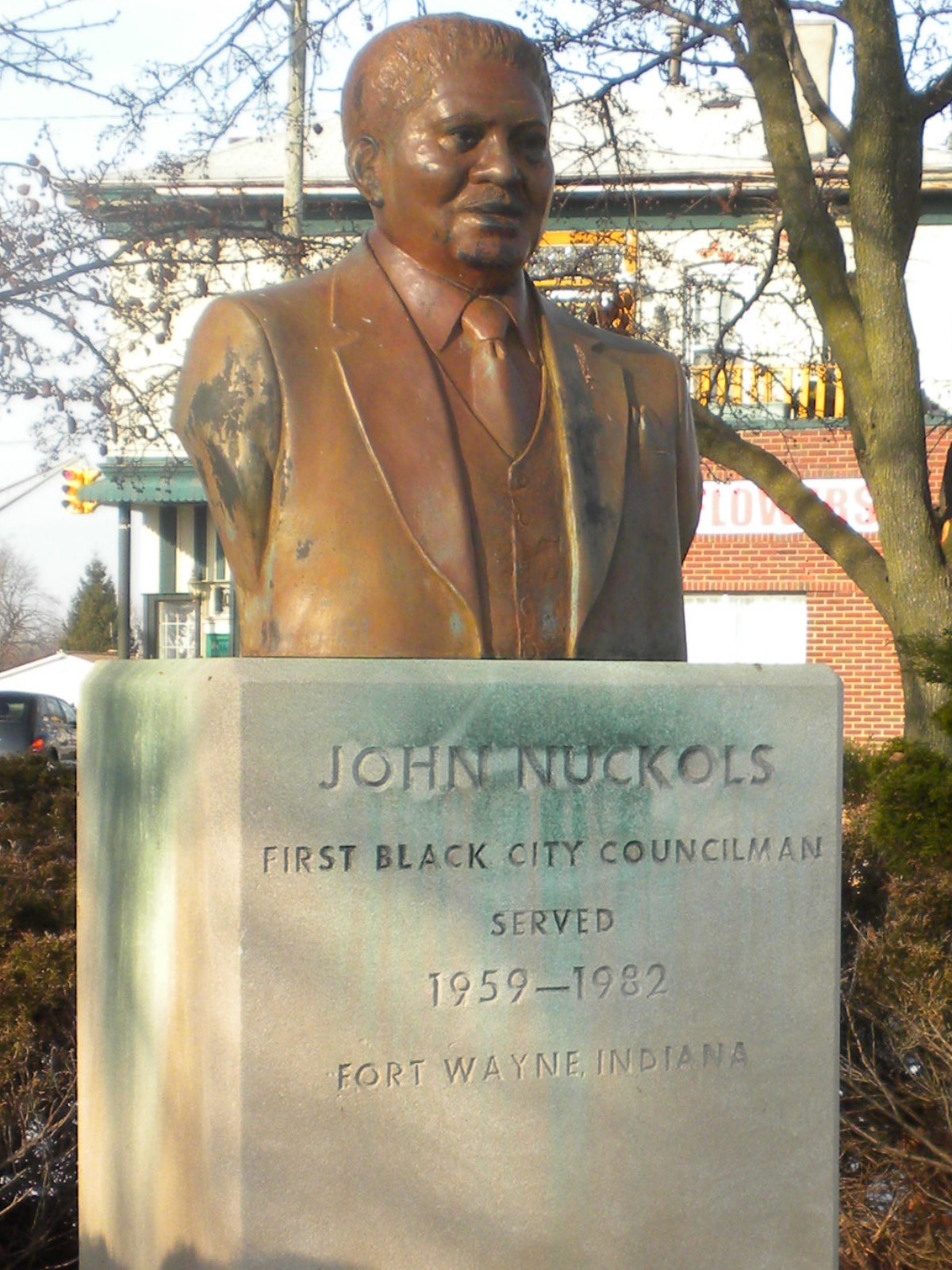
Our first stop was at the corner of Harmar and Maumee Avenue. The bust of John Nuckols is in Nuckols Park, across the street from Carmichael Funeral Home. Nuckols was the first African American to serve on Fort Wayne’s City Council, which he did for 23 years, representing the first district.


According to the Fort Wayne Parks and Recreation web site, Nuckols Park was purchased in 1876 from Fred Hayden for $4500 and was known as Hayden Park until 1986. The famous statue of General Anthony Wayne resided in Nuckols Park until it was relocated to its current Freimann Square location in 1973. Now, the park features a memorial of its namesake, John Nuckols, the first African-American city councilman.”


From Nuckols we drove over to the Gas House to take a shot of the statue of Charles Louis Centlivre.

Centlivre

Centlivre was a Frenchman who moved to Fort Wayne and established a brewery at the north end of Spy Run.

The statue was a tribute from his employees, who had the creation installed on top of the Old Crown Brewery after their employer’s retirement.


IAS files indicate the sculpture was blown off the roof of the brewery by high winds in March 1964 and moved by Hall’s Restaurants in 1974 to its current location on the corner of Spy Run and Superior Streets.


Exiting the Gas House parking lot, we drove under the railroad tracks into the parking area behind the Arts United Center. From there we connected to Clinton and took some photos of the Anthony Wayne statue in Freimann Square.

Wayne

It was a really cold day so we did not park the car to take a close look at this sculpture. But on a warmer day it’s well worth your time to walk through the square and take a closer look.


Anthony Wayne – “Mad Anthony” – is the name sake of our city and a character from history worth further exploration. You can see his camp bed and other artifacts from his time in Indiana at the History Center.


From Clinton we drove over to Lake and Crescent to see the statue of Henry Lawton. This is one of my favorite Fort Wayne statues.

Lawton

Lawton was a Civil War hero and the first Fort Wayne native to win the Congressional Medal of Honor. The story of his life is truly interesting and the statue on the corner presides well over the neighborhood.

One of the many mysteries in Fort Wayne is why Lawton is in Lakeside Park, and not Lawton Park.

Civil War Monument


We then ventured to Tennessee and parked long enough to take a photograph of the Civil War Monument in Lawton Park on Spy Run.

Headwaters Park and Lawton Park have a number of statues that you can view and a nice warm day is the best time to do this.

The Civil War Monument is the oldest public sculpture in Fort Wayne.


Headwaters Park is also home to a statue of Little Turtle and sculptures of the Hamilton sisters, one of whom wrote “Hamilton’s Mythology” that so many of us used as a text book in high school.

Lincoln


As we drove home, we went a little out of our way down to one of the Lincoln buildings on Harrison across from the Adair Federal Building. The statue there of Abraham Lincoln was created by Paul Manship and completed in 1932.

Manship was a world-renowned sculptor who chose to portray Lincoln as a young man looking forward to fulfilling his dreams. Prior to his death in 1966, Manship produced a large number of coins and medals, including the JFK inaugural medal.


Heading out Washington we noted the statues of David Foster and Perry Randall where the street swoops around to become Jefferson. This is no place to slow down for a drive-by sighting but you can pull into Swinney Park to take a closer look at the statue of Foster. Foster is the founder of the Fort Wayne parks system. The inscription on his statue speaks to the importance of remembering and honoring those who shaped this city:


“He will live forever, not because of his military record, not by reason of his business career but by the laughter of the children, the strength of the youth, the joy of the middle-aged who shall live and love and prosper and know real happiness in the Greater Fort Wayne of Tomorrow, which is his dream come true.”


“Who Put That There” contains far more statues and sculptures than we featured here. But as you can see, you can map out a wonderful drive (or two) around our city to take a look at our history and perhaps spur yourself and your children to learn more about the people who made Fort Wayne what it is today.


You can also find more information about these and other historical figures at the Allen County Public Library, in books at the History Center, and on the internet. And watch this blog for more stories of Fort Wayne.