Showing posts with label The History Center. Show all posts

Thursday, September 25, 2014

Johnny “Appleseed” Chapman


by Tom Castaldi 


John Chapman, also known as Johnny Appleseed, serves as an example of a part of the religious fervor on the western frontier in the years before the Civil War.  The legends and tales about him that grew even in his own lifetime rivaled those of his contemporaries, Davy Crockett and Daniel Boone.  Like them, Chapman’s career in the wilderness as a preacher and Good Samaritan quickly got caught up in the American imagination. 


Johnny Appleseed had been on the frontier for several decades before coming to Fort Wayne, possibly as early as 1822.  Already many stories were told of this gentle man’s propagation of fruit trees in odd plots of land all over the Pennsylvania and Ohio wilderness, his love of wildlife, and the awe in which the Indians held him up as a powerful medicine man.  He repeated the Bible verse “refresh me with apples” declaring “with apples shall men be comforted in the wilderness of the West.”  A holy man he was, for his principal aim was to bring “some news right fresh from heaven” as he read from the Beatitudes to the settlers he visited in cabins in the forest telling of the spiritual happiness he enjoyed through the teachings of the Church of New Jerusalem.

One eyewitness described Johnny Appleseed’s appearance when he came to Fort Wayne as “simply clad, in truth clad like a beggar.  His refined features told of his intelligence, even though seen through the gray stubble that covered his face since he cut his hair and beard with scissors. Johnny was serious, his speech clean, free from slang or profanity.  He traveled on foot – sometimes with just one shoe or two different kinds of boots.”  Some descriptions have him wearing his cooking pot for a hat, at times with other parts of hats – the crown or the brim – on top of his tin cap.  Other biographers claim that because his mush-pot hat did not protect his eyes from the bright sun well enough that he fashioned one made of pasteboard with a large peak in front.  Although his eccentric appearance occasionally caused anxiety or even alarm in some people, by and large, he was well liked for his sincere and kind ways.

Exceptionally strong for his tall slim frame, one pioneer observed that Johnny Appleseed was able to get more work done clearing the forests in one day than most men could finish in two.  Above all else, however, he was appreciated for his great ability to tell stories about his church, of his many adventures on the frontier, his narrow escapes in the wilderness, his dealings with the Indians, and his association with the wildlife of the Midwest, from bears to wasps.

He showed a great reverence for all life, including the lowly insects.  One story often told was that when he was being stung by a hornet that had crawled into his shirt, he carefully removed his shirt to allow the creature to go on its way unharmed rather than kill the stinging nuisance.  On another occasion he put out his evening camp fire to avoid the possibility of the moths being destroyed in the flames.  He was known to have purchased an aged horse from a pioneer who was continuing to put the creature to work, in order that the animal could spend its last days peacefully at pasture. A settler once described him saying that he was like “good St. Francis, the little brother of the birds and the little brother of the beasts.”

Johnny Appleseed's monument near the Coliseum in Fort Wayne.


Johnny Appleseed died in 1845 at the age of 71.  He had been protecting his saplings from some cows that had broken down the fence of one of his orchards just north of Fort Wayne.  He was overcome by his exertions and succumbed to what the people of the time called the “winter plague.”  He was buried along the St. Joseph River and the old feeder canal bed on the Archer farm, but the actual site is not known today; a commemorative marker sits atop the hill in present-day Johnny Appleseed Park, which was once the Archer family cemetery. Each year during the Fort Wayne festival that bears his name, visitors remember the comfort John Chapman brought to the west, for around his memorial children fondly place their gifts of apples.


The flask pictured on this sign is on display at the History Center.

Originally published in Fort Wayne Monthly “Along the Heritage Trail with Tom Castaldi”
  Apr 2009 No 53


Allen County Historian Tom Castaldi is author of the Wabash & Erie Canal Notebook series; hosts “On the Heritage Trail,” which is broadcast at 6:35 a.m., 8:35 a.m. and 6:30 p.m. Mondays on WBOI, 89.1 FM; and “Historia Nostra” heard on WLYV-1450 AM and WRRO 89.9 FM. Enjoy his previously published columns on the History Center’s blog, “Our Stories,” at history centerfw.blogspot.com.

Wednesday, April 16, 2014

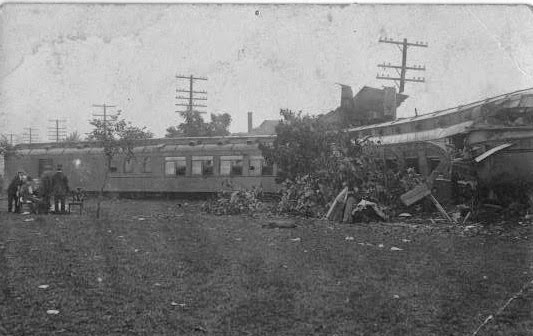
Fort Wayne's Worst Train Wreck


by Nancy McCammon-Hansen

There’s nothing like an accident to bring out the gawkers and that certainly was true when Fort Wayne’s worst train wreck within the city limits occurred on August 13, 1911.


A speeding Pennsylvania Railroad passenger train, trying to make up for lost time, crashed into a freight train in Swinney Park. Three railroad workers were killed and 35 passengers and other crew members injured. (Some reports say four were killed and 30 injured.) The train was reportedly going about 50 miles an hour, traveling from Chicago to New York, when it left the track at a switch around 6:30 p.m. and crashed into the freight train. Two engines were pulling the passenger train and as they left the rails, they sideswiped the engine of the freight train.


“The baggage car, smoker, buffet, and two sleepers turned over in the ditch. Most of the injured were seated in the diner and smoker when the accident occurred,” according to the website www.historictornadoes.com/disasters/train-wrecks-accidents. Fortunately for the passengers, the train was composed of all-steel cars that survived the crash far better than “old-fashioned wood construction”. The engines of the passenger train were thrown down an embankment and the freight train’s engine “reared up over the trucks of the fliers (sic) engine”.


The information on the historictornadoes.com website was transcribed from The Washington Post District of Columbia 1911-08-14.

Other information in this blog post comes from Scott M. Bushnell’s book “Historic Photos of Fort Wayne”, which is for sale in our gift shop.

The photos come from postcards in the History Center’s collection.

Thursday, October 10, 2013

The Magnet Wire Capital of the World


by Tom Castaldi

The Magnet Wire Wall in the new permanent exhibition gallery Allen County Innovation at the History Center.
Magnet wire had its modern beginnings in a small building south of Swinney Park where Superior Essex currently occupies its present-day administration operations and the Fort Wayne plant.

            Enamel successfully applied to wire to produce magnet wire – the insulated copper or aluminum wire that is wound in coils to create electromagnetic fields – was developed in Fort Wayne, and Fort Wayne gained the title of “The Magnet Wire Capital of the World.”

Copper in its various forms
George Jacobs, the founder of the U.S. magnet wire industry, was a bright young chemist at General Electric’s Fort Wayne Works in 1901, working on the problems of wire insulation.  By 1911, Jacobs had left G E and with his wife Ethel perfected a process of enameling, or insulating wire, for use in coils. 

When Ethel’s mother, Emma, died in 1911, George and Ethel Jacobs were persuaded by her father William to return to Fort Wayne from Cleveland.  William Mossman yearned to be near his daughter and offered to establish a laboratory in Fort Wayne for Ethel and her husband to pursue their interests.

            With this new product development, George Jacobs and his associate Victor Rea further developed, enabled wire of any thickness to be coated evenly with a chemical insulation that could be baked on in special ovens and yet remain flexible enough to be wound into coils.  It’s those coils in motors and transformers that make them work and it is a motor or a transformer that is at the heart of labor saving devices that do our work and make our lives more comfortable. From this modest beginning at the end of Wall Street on Fort Wayne’s near south side emerged one of the modern world’s most important products: magnet wire. Without magnet wire, most electrical devices that are common features of everyday life electric motors, computers, televisions, radios, automotive devices, hearing aides, telecommunications equipment and much more would be impossible.

          
Forms of wire

An electric motor
        Jacobs formed Dudlo Wire Company, as the original magnet wire manufacturer in Fort Wayne.  Today, Superior Essex, Rea Magnet Wire and the former Phelps Dodge Magnet Wire Company, along with other wire operations trace their origins to this early triumph of George and Ethel Jacobs and the Dudlo Wire Company.


This article originally appeared in Fort Wayne Magazine “Along the Heritage Trail with Tom Castaldi” – Aug 2006 No. 2. Allen County Historian Tom Castaldi is author of the Wabash & Erie Canal Notebook series; hosts “On the Heritage Trail,” which is broadcast at 6:35 a.m., 8:35 a.m. and 6:30 p.m. Mondays on WBOI, 89.1 FM; and “Historia Nostra” heard on WLYV-1450 AM and WRRO 89.9 FM. Enjoy his previously published columns on the History Center’s blog, “Our Stories,” at history centerfw.blogspot.com.

Tuesday, May 7, 2013

Do you suppose this is worth something to somebody?


by Mark Meyer

In a perfect world archivists would have unlimited climate-controlled storage space,  a huge staff of material handlers, and the ability to never say “no” to anyone willing to donate material to their collection. Unfortunately, they don’t have those luxuries. Deciding what to accept to a collection is a never-ending challenge to curators that manage their collections. In speaking to local archivists from the Allen County Public Library, the ACPL Lincoln Collection, and The History Center, it was clear nothing is black-and-white when it comes to donating historical items. There are no hard and fast rules on donations but there are a number of things for you to keep in mind if you have items to donate that you feel may have historical or research value.

Provenance and history
Learn as much as you can about the item(s) you are wishing to donate to help the curator determine its value to his/her collection. That box of snapshots would take on a different value if they were work photos from International Harvester versus family pictures of little brother’s 14th birthday party down in the basement. You needn’t do extensive research, in fact the best information is likely that provided by talking to those around you. As Aaron Smith from the ACPL Genealogy collection suggested, “…there’s no more valuable source than Aunt Millie.” A personal, local connection (especially for The History Center) creates greater value.

Ask
One thing is clear, no archivist wants to provide a blanket list of “yes” and “no” items so your next step is to contact the organization to which you wish to donate. Simply call or email to provide an idea of the item or items you wish to provide.  There are an almost unlimited number of items of historical value but the organization may not have a home for your item for other reasons than value.  For History Center curator, Walter Font avoiding duplication is a big consideration. Display and storage space is limited so the uniqueness of an item is important to maximize collection space. There could also be issues with physical size of an item or, in the case of paper records, the sheer volume of material. Staff time to process the materials could be a consideration as well. But, remember, there are no rules. That huge item in your backyard or that collection found in a warehouse still may be desirable.

Preparation
Once you’ve found a willing home you can ascend to the Donator Hall of Fame by taking some steps to make your donation more manageable. Some steps may sound rather obvious but you’d be surprised according to ACPL Lincoln Librarians Jane Gastineau and Adriana Maynard. They have seen their share of “buggy” boxes filled with cobwebs, nests, and dreaded silverfish.

Clean boxes please. Besides the obvious “yuck” of a buggy box, the insects and nests pose a threat to the organization’s collection. Yes, sometimes an organization might be willing to fumigate a particularly rare collection of donated items but in general, if you can help by donating in a clean, dry box, please do so. As Gastineau noted, watermarks on the outside of a box suggest there may be some dampness issues within, making it a candidate for a new dry box. (A special note on old textiles: please DON’T wash.  Chances are the item needs a special cleaning process or may be preferred as-is.) 

Organize. Organize the material as best you can whether by size, date, or material.  It’s not critical how you organize but it is very helpful to use a single method. Be sure to clearly note what method was used.

Avoid paper clipping, stapling, and binding with rubber bands. The metal of the former rusts while the rubber of the bands breaks down and may stain or damage surrounding material. These would all have to be removed for archiving so save both you and the archivist some time by avoiding clips and bands. 

Don’t mount or frame or place in sleeves. Vintage photo albums and scrapbooks can be treasure troves of information but often contain acidic paper, glues, or cumbersome plastic pages or sleeves. Yes, those vintage items are desirable, but there is no need to assemble your donated items in a binder or scrapbook. Your items may be in storage for an extended period before being processed so avoid making the mistakes of those vintage scrapbookers.  Also, plastic sleeves provide protection but in most cases create a great deal of additional work for those processing the donation. Smith, who manages the ACPL Genealogy archives, noted that in this day of digital scanning, paper items need to be removed from the sleeves to be scanned. This adds a step to an already time-consuming process. In some cases donated papers can be bound as-is in hard back volumes but sleeves complicate the process. Smith has attended many a club meeting with attendees separating papers from sleeves as the meeting progressed! Finally, the History Center’s Font advises to refrain from the unnecessary expense of framing. A frame may make that document or letter more attractive but the item will most likely be removed from the frame for proper preservation and/or display. 

Identify. There may be no single activity of more value to the curator than providing background information for the item(s) you donate. An old group photo of a dinner takes on new meaning when the event and the individuals are identified. Please don’t mark directly on the item (You’d be surprised!) but instead note on a separate piece of paper or post it note. Give as much detail as possible with special attention to names, dates, and locations. Chances are that you are the very best source for information about the item. As ACPL’s Smith notes, “…information degrades the further it gets from you”.  Your notes will set a good foundation and help keep the info flow intact. 

Copyright, taxes, and all that legal stuff
Be aware that your donation may become the property of the particular archive and as such be subject to the rules of access established by that organization.  In some cases, for instance papers, manuscripts, photographs and other original material, you may be asked to provide a copyright waiver.  You may also qualify for a tax credit.  The organization to whom you are  donating can provide additional information but it may be to your benefit to consult your attorney or accountant to determine the maximum tax benefit (if any) to which you’re entitled.

Despite these suggested guidelines I couldn’t help but feel any of the professionals I consulted would happily throw them all out in a heartbeat if your donation contained items of value to their collections. Don’t let this laundry list discourage your donation.  And conversely, don’t give up if an organization says, “no”.  Back in the ‘90s I contacted several local organizations looking for a home for hundreds of hours of local news footage from a TV station’s archives. Due to the collection size and its dated film and videotape format, no local organization could accept the donation. Fortunately it found a home at the Indiana State Museum which had the staff and warehouse to accommodate it. The real bottom line here is preserving links to our past. If we are able to do this in a manner most efficient for those folks who catalog, organize, preserve, and protect this priceless info, well, all the better.