Showing posts with label History Center. Show all posts

Thursday, August 14, 2014

Fort Wayne’s Old City Hall


by Tom Castaldi

The Fort Wayne City Building, later to be known as "The Old City Hall," and still later as “The History Center” was designed by local architects John Wing and Marshall Mahurin and was dedicated on April 20, 1893, by Mayor Charles Zollinger.

          At first, some referred to the building as, "The Hapsburg Horror" as a jest about the German ancestry of the mayor.  Before the City Building was opened, Fort Wayne had no city hall.  In the years after 1840, when Fort Wayne was incorporated as a city, official business was conducted in scattered locations throughout the Court Street area.  Only the plot of land donated by Samuel Hanna at Barr and Berry Streets had been set aside for the town's public business.

An early photo of the "Old City Hall"


Here, in 1855, a simple market place was built. Because of the great inconvenience and disorderly organization of the young city bureaucracy, the Council ordered in 1869 that a new market building be built to replace the old structures.  Further, offices in this building were to be provided for the City Clerk and the City Treasurer. The mayor still had to find his own office elsewhere.

          Despite all the improvements to the market building, by the 1880s the great increase in population and the expansion of developed land in the city made it clear that more suitable municipal facilities would be required.  Plans for a new building began during the 1885 to 1889 administration of Mayor Charles F. Muhler, but it was in the administration of Charles Zolinger that the project was finally realized, at a cost of almost $70,000 or in today’s currency more than $1,500,000.

Note the carvings on the stonework


          The new building offices were provided for the mayor, treasurer, engineer, clerk, and Common Council, as well as the municipal court and police department.  The northern end of the building was designed for general public business, with a fine marble floor on the first level.  The City Court and the City Council Chambers graced the same room on the second level.  At the south end of the building were both the police department and the jail, most often referred to as the "calaboose."  A hidden stairway allowed officers to escort offenders to the second-floor courtroom without having to go up the public stairways.  At the turn of the century the garage housed the city paddy wagon and rescue boat, and there was a hayloft for the horses, which were stabled nearby.

Our newest gallery--Allen County Innovation

First floor hallway outside the new gallery


          In 1971, the city had outgrown the Old City Hall, and it was abandoned as city offices moved into the new City-County Building on Main Street. In 1979, the Allen County-Fort Wayne Historical Society rehabilitated the Old City Hall to create the History Center, which was opened to the public in October 1980. Currently, the building is undergoing its largest renovation in a generation to stabilize and enhance the museum that continues to serve our community celebrating our county’s collective memory.

View from the parking lot

 
Stonework was cleaned and refurbished last fall

Originally published in Fort Wayne Magazine “Along the Heritage Trail with Tom Castaldi” – Oct. 2008 No. 47
 

Allen County Historian Tom Castaldi is author of the Wabash & Erie Canal Notebook series; hosts “On the Heritage Trail,” which is broadcast at 6:35 a.m., 8:35 a.m. and 6:30 p.m. Mondays on WBOI, 89.1 FM; and “Historia Nostra” heard on WLYV-1450 AM and WRRO 89.9 FM. Enjoy his previously published columns on the History Center’s blog, “Our Stories,” at history centerfw.blogspot.com.


Saturday, July 6, 2013

Dearly Departed...and the Fort Wayne Fire Department


by Nancy McCammon-Hansen

Dearly Departed is July 15 and ARCH and the History Center hope you all come out to Lindenwood Cemetery for the program which begins at 4:30 p.m. and runs until 7:30 p.m. Lindenwood is one of the more beautiful spots in Fort Wayne and SO full of history.

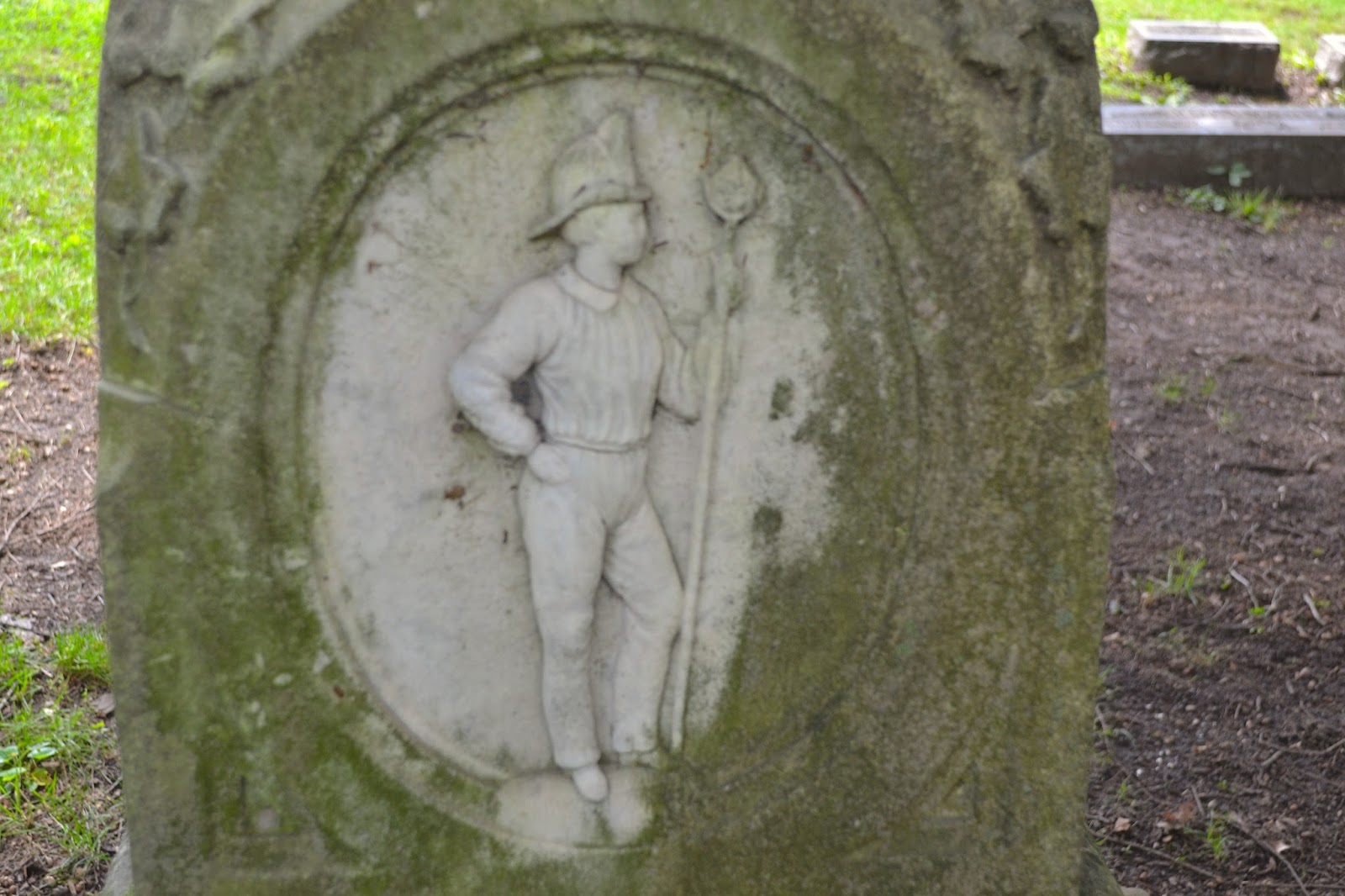
In a previous post, I mentioned Frederick Hilsman, the first Fort Wayne fire fighter to die in the line of duty. Hilsman was trapped in the basement of the Boltz Grocery and suffocated in smoke from a fire caused by a leaking barrel of "rose oil", a kerosene type mixture.

Here are some photos of his headstone....note the fire fighter's helmet on the top of the stone and the fire fighter on the stone's side.


Wednesday, April 3, 2013

Massacre at Fort Dearborn


by Carmen Doyle

The battle at Fort Dearborn wouldn’t seem to have much to do with Fort Wayne. After all, the battle took place in what is now Chicago! But there IS a connection that leads us to share with you this interesting bit of history.

William Wells had been kidnapped by Miami Indians in Kentucky when he was an adolescent. He adapted to the Indian way of life, becoming Little Turtle’s son-in-law and fighting on the Miami side in the defeat of St. Clair in Ohio. Shortly after that, Wells decided to stop fighting on the side of the Indians. He became a scout and interpreter for General Anthony Wayne. Wells also served as the first Indian agent for Fort Wayne.

When the War of 1812 was declared, the British attacked Fort Detroit. The Commander of  the U.S. Army of the Northwest, William Hull, surrendered. Fearing that Fort Dearborn could no longer be adequately supplied, Hull ordered the commander at Fort Dearborn to evacuate and retreat with all the soldiers and residents to Fort Wayne.

Wells had a niece, Rebekah, from his Kentucky family. Rebekah had married Nathan Heald, who was the Commander at Fort Dearborn.

(An interesting fact is that Fort Dearborn was designed by John Whistler, who also designed Fort Wayne. John Whistler’s grandson painted the now famous “Whistler’s Mother”.)

Fort Dearborn was in an area held by the Potawatomi Indians, who were hostile to the Americans. On August 9, 1812, Heald received orders from Hull to distribute all provisions from Fort Dearborn to the Potawatomi in hopes of the Potawatomi providing a safe passage to Fort Wayne.  However, all spare weapons and ammo, along with the whiskey, was to be destroyed. Heald worried that the Indians would make “bad use of it if in their possession”.

On August 12, William Wells arrived at Fort Dearborn with 30 friendly Miami to provide an escort for the evacuees back to Fort Wayne. The next day, a meeting between Captain Heald and the Potawatomi was held and Heald told the Potawatomi that he intended to leave the fort. The Potawatomi believed that this meant that all the guns, ammo, provisions and whiskey would be given to them. They also believed that if they escorted the evacuees to Fort Wayne, they would get money.

On August 14, a friendly Potawatomi chief, Black Partridge, warned Heald that there would likely be an attack, as he could no longer hold back the young men of the tribe.

On August 15, the garrison left Fort Dearborn on their way to Fort Wayne. There were 93 people in the party, including noncombatants (mostly women and children). William Wells (his face painted black in the Miami tradition of a warrior willing to fight to the death) along with some of the friendly Miami, led the evacuation.

Less than two miles after leaving the Fort, the garrison was attacked by a large number of Potawatomis.

According to Heald’s report, when the company was attacked, they marched to the top of a nearby sand dune and attempted to charge the Indians. However, this had the effect of separating the cavalry from the wagons carrying provisions and the noncombatants. The Potawatomis charged the gap and began to tomahawk and scalp the people in the wagons, according to an account published later in the Fort Wayne Daily Gazette.

When Wells saw what was happening, he tried to ride to help those in the wagons. Before he could make it, however, he was surrounded by Potawatomis. He fought back and killed many of the Indians who were fighting him, but there were so many that he was shot and killed. When he was dead, the Potawatomis cut out his heart and ate it in the belief that William Wells’ courage would be passed on to them.

The battle lasted just 15 minutes.  Over half the garrison--52 Americans--were killed.

There are two different versions of what happened to the Miami escort that William Wells had brought with him. They either fought alongside the Americans or turned and ran when the fighting started.  The differing accounts led William Henry Harrison to claim that the Miami fought AGAINST the Americans and used the massacre as an excuse to attack Miami villages. The attack on Miami villages made Chief Richardville and Pacanne side with the British in the War of 1812- but the Americans still won the war.

Here are some books available at the History Center on William Wells:


  • Blacksnake’s Path by William Heath

  • Heart of a Warrior by Joe Krom (fiction)

  • Miami Indians of Indiana by Stewart Rafert

  • Outpost in the Wilderness: Fort Wayne, 1706-1828 by Charles Poinsette

  • On the Heritage Trail- Bicentennial Heritage Trail Committee

  • Land of the Indians: Indiana by Karl A. Kieper

Wednesday, January 30, 2013

The Capture of the Bride

We're serializing this Old Fort News piece from July-September, 1960. Here's the first part of the story:


Introduction

On June 15, 1777, the entire population of Boonesborough, Kentucky, met at the home of Captain Luther Miller to celebrate the wedding of his daughter, Martha, to Samuel Vance. How their day of feasting and celebrating ended in tragedy is related in this paper.

The article appeared in the INDIANAPOLIS NEWS, October 19, 1898, and was signed by Edward F. Colerick. The Allen County-Fort Wayne Historical Society presents the story, as it appeared, hoping it will entertain the readers.

Alene Godfrey, editor


The Capture of the Bride

            Boonesborough, Kentucky, the home of the renowned backwoodsmen, Daniel Boone and his brother ‘Squire Boone, was protected by a strong palisade fort, with blockhouses, designated and erected by Daniel Boone. It was regarded as safe at that time. On account of the great protection afforded by this fortification, many emigrants settled there.
            A wedding was announced to take place June 15, 1777, at the home of Captain Luther Miller, three miles from Boonesborough, on the main trace. His oldest daughter, Martha, was to be married to Samuel Vance, a young man of the neighborhood. As was the custom, the entire population, old and young, was invited to be present and partake in the festivities.
            About the 2nd of the month Indians made their appearance in the settlement, having killed and scalped a boy who was in the woods hunting for a cow and a calf. This created much uneasiness throughout the settlement, as it was not known how many Indians were in the vicinity. The intention of making the approaching wedding a public one was about abandoned, when it was reported that the savages, being few in number, had made a hasty retreat from the settlement. When the wedding day arrived confidence was restored and the Indians about forgotten. Yet, two of the older settlers, who, from habit, were always on the alert, came with their rifles on their shoulders and scalping knives and tomahawks in their belts, prepared for any emergency. 


Retired to the cabin
            In the presence of a large and joyous assembly the two were united. The ceremony consisted of the contract, with witnesses, and religious vows administered by Daniel Boone’s brother, ‘Squire Boone, who was an occasional preacher of the persuasion popularly known as “Hard Shell Baptists.” The formal license from the county court was not waited for, as the courthouse of Fincastle, of which county Kentucky was a part, was distant more than six hundred miles.
            After a day of feasting and pleasure the older persons, with their children returned to their homes before nightfall, while the young folks kept up the festivities during the evening. About nine o’clock, while the dancing was still going on, the bride slipped away, accompanied by her sister Sarah, age sixteen and her aunt Eve (an elderly maiden aunt, her father’s sister), and a neighbor lad of fifteen years, went over to the Vance cabin, distant about five hundred yards, to put things to rights. The neighbors had erected them a one-room cabin, which was furnished and ready for occupancy. They swept the floor and adjusted the bed, which had been used through the day by the mothers as a place to deposit their babies while they slept, away from the noise and confusion.
            Having completed the object of their visit, the four were about to join the merrymakers. Says the aunt:
           
Being in a hurry, I started first. The night was very dark and cloudy. I had reached about halfway between the two houses, when I saw in the darkness figures approaching ahead of me. I supposed they were some of the young folks coming after us. I stepped to one side, soon the figures came so near that I saw they were Indians. I had on a dark dress, and they did not observe me. I started in a roundabout way through the woods, screaming as I ran “Indians! Indians!” In the excitement I ran against a tree with such force it knocked me down. It was some moments before I regained my senses. As I lay on the ground I could hear the dear creatures at the cabin, shrieking in the greatest agony. Then all became as still as death. I supposed the fiends had murdered them all. I now regained my feet, and hurried in the direction of the dim lights, which I could see all the time, and soon reached the house, giving the alarm.

To be continued......