Showing posts with label Fort Wayne History. Show all posts

Thursday, October 9, 2014

First Fort of the Fort


by Tom Castaldi

Fort Wayne’s first fort was built as a dream of the French, and especially the renowned 17th century explorer Robert Sieur de La Salle, to create a wilderness empire that arced through the Great Lakes and the Mississippi River valley from Quebec to New Orleans. This empire would be firmly anchored on military and trading strongholds and Indian alliances. Because the Maumee-Wabash portage was the most direct link between New France in the upper Great Lakes and the Mississippi River, the Three Rivers region was particularly important. An outpost at the confluence of the rivers would become a key stronghold in a string of forts cutting through the heart of the wilderness from the area of Detroit to St. Louis. In what is now called Indiana, other key French strongholds were located in present day Lafayette and Vincennes.


The French lived among the Miami at the Three Rivers as early as 1697 when Jean Baptiste Bissot, Sieur de Vincennes (who died in 1719), and Francois Marie Bissot de Vincennes, the son of Jean Baptiste (who died in 1736), served as royal agents to the Miamis. The elder Vincennes may have built a trading post at the Three Rivers as early as 1706, but the first fort was built in 1722 on this site by Captain Dubuisson upon the orders of the French governor in Quebec. The fortification was called Fort St. Philippe or Fort Miamis, was garrisoned by as many as thirty men, and commanded the portage between the St. Mary's and Wabash rivers.

In the 1740s, tensions between France and England increased greatly over competing trading rights in the Midwestern frontier. In response to English expansion into the wilderness north of the Ohio River, the French sent several military expeditions to push out the English. Although some English traders were expelled, superior trade goods and other promises offered by the British merchant adventures lured the region's Indian peoples to new English trading centers. In 1747, the Wyandot chief Sanosket, known also as Old Britain or La Damoiselle, encouraged by the British, attacked and burned Fort St. Philippe, partially destroying it. He and his people, along with many of the area Miamis, moved to the new British trading post at Picawillany, near modern Piqua, Ohio. Chief Cold Foot, a firm supporter of the French, remained at the Three Rivers, and the area around the first French fort came to be known as "Cold Foot's Village." A smallpox epidemic struck in 1751 and killed many of the Miamis, including Cold Foot and his son.


A new French commandant, Captain Charles DeRaimond, repaired the fort in 1747 and used it for three years. When a senior French officer, Pierre Joseph Celoron, Sieur de Bienville, led his strong expedition through the region in 1749 to counter British influence, he stopped at the dilapidated old Fort St. Philippe. Accompanying him was the priest and scientist, Reverend Pierre Joseph de Bonnecamps, who described the place at the time as being "in very bad condition" with "eight miserable huts, which only the desire of making money could render endurable." There were 22 French present and everyone "had the fever," including the commandant. The palisades were in ruins. A new fort was built the next year two and a half miles by way of the Saint Mary’s and on up the St. Joseph River.


A century and a half later on May 20, 1911, the same ground that served a fortress was dedicated as Fort Wayne’s first public playground and designed as a safe place for children to enjoy its swings, see-says, wading pools and sand boxes. You can still visit the place where the first French fort stood on the south side of the Saint Mary’s River in the vicinity of a pleasant grassy open space near Van Buren Street Bridge. What began as a stronghold to secure a route for a wilderness empire became a playground park.


Originally published in Fort Wayne Monthly “Along the Heritage Trail with Tom Castaldi” – May 2009 No. 54
Allen County Historian Tom Castaldi is author of the Wabash & Erie Canal Notebook series; hosts “On the Heritage Trail,” which is broadcast at 6:35 a.m., 8:35 a.m. and 6:30 p.m. Mondays on WBOI, 89.1 FM; and “Historia Nostra” heard on WLYV-1450 AM and WRRO 89.9 FM. Enjoy his previously published columns on the History Center’s blog, “Our Stories,” at history centerfw.blogspot.com.


Thursday, September 25, 2014

Johnny “Appleseed” Chapman


by Tom Castaldi 


John Chapman, also known as Johnny Appleseed, serves as an example of a part of the religious fervor on the western frontier in the years before the Civil War.  The legends and tales about him that grew even in his own lifetime rivaled those of his contemporaries, Davy Crockett and Daniel Boone.  Like them, Chapman’s career in the wilderness as a preacher and Good Samaritan quickly got caught up in the American imagination. 


Johnny Appleseed had been on the frontier for several decades before coming to Fort Wayne, possibly as early as 1822.  Already many stories were told of this gentle man’s propagation of fruit trees in odd plots of land all over the Pennsylvania and Ohio wilderness, his love of wildlife, and the awe in which the Indians held him up as a powerful medicine man.  He repeated the Bible verse “refresh me with apples” declaring “with apples shall men be comforted in the wilderness of the West.”  A holy man he was, for his principal aim was to bring “some news right fresh from heaven” as he read from the Beatitudes to the settlers he visited in cabins in the forest telling of the spiritual happiness he enjoyed through the teachings of the Church of New Jerusalem.

One eyewitness described Johnny Appleseed’s appearance when he came to Fort Wayne as “simply clad, in truth clad like a beggar.  His refined features told of his intelligence, even though seen through the gray stubble that covered his face since he cut his hair and beard with scissors. Johnny was serious, his speech clean, free from slang or profanity.  He traveled on foot – sometimes with just one shoe or two different kinds of boots.”  Some descriptions have him wearing his cooking pot for a hat, at times with other parts of hats – the crown or the brim – on top of his tin cap.  Other biographers claim that because his mush-pot hat did not protect his eyes from the bright sun well enough that he fashioned one made of pasteboard with a large peak in front.  Although his eccentric appearance occasionally caused anxiety or even alarm in some people, by and large, he was well liked for his sincere and kind ways.

Exceptionally strong for his tall slim frame, one pioneer observed that Johnny Appleseed was able to get more work done clearing the forests in one day than most men could finish in two.  Above all else, however, he was appreciated for his great ability to tell stories about his church, of his many adventures on the frontier, his narrow escapes in the wilderness, his dealings with the Indians, and his association with the wildlife of the Midwest, from bears to wasps.

He showed a great reverence for all life, including the lowly insects.  One story often told was that when he was being stung by a hornet that had crawled into his shirt, he carefully removed his shirt to allow the creature to go on its way unharmed rather than kill the stinging nuisance.  On another occasion he put out his evening camp fire to avoid the possibility of the moths being destroyed in the flames.  He was known to have purchased an aged horse from a pioneer who was continuing to put the creature to work, in order that the animal could spend its last days peacefully at pasture. A settler once described him saying that he was like “good St. Francis, the little brother of the birds and the little brother of the beasts.”

Johnny Appleseed's monument near the Coliseum in Fort Wayne.


Johnny Appleseed died in 1845 at the age of 71.  He had been protecting his saplings from some cows that had broken down the fence of one of his orchards just north of Fort Wayne.  He was overcome by his exertions and succumbed to what the people of the time called the “winter plague.”  He was buried along the St. Joseph River and the old feeder canal bed on the Archer farm, but the actual site is not known today; a commemorative marker sits atop the hill in present-day Johnny Appleseed Park, which was once the Archer family cemetery. Each year during the Fort Wayne festival that bears his name, visitors remember the comfort John Chapman brought to the west, for around his memorial children fondly place their gifts of apples.


The flask pictured on this sign is on display at the History Center.

Originally published in Fort Wayne Monthly “Along the Heritage Trail with Tom Castaldi”
  Apr 2009 No 53


Allen County Historian Tom Castaldi is author of the Wabash & Erie Canal Notebook series; hosts “On the Heritage Trail,” which is broadcast at 6:35 a.m., 8:35 a.m. and 6:30 p.m. Mondays on WBOI, 89.1 FM; and “Historia Nostra” heard on WLYV-1450 AM and WRRO 89.9 FM. Enjoy his previously published columns on the History Center’s blog, “Our Stories,” at history centerfw.blogspot.com.

Wednesday, September 24, 2014

Portraits in the Grand Staircase


by Carmen Doyle

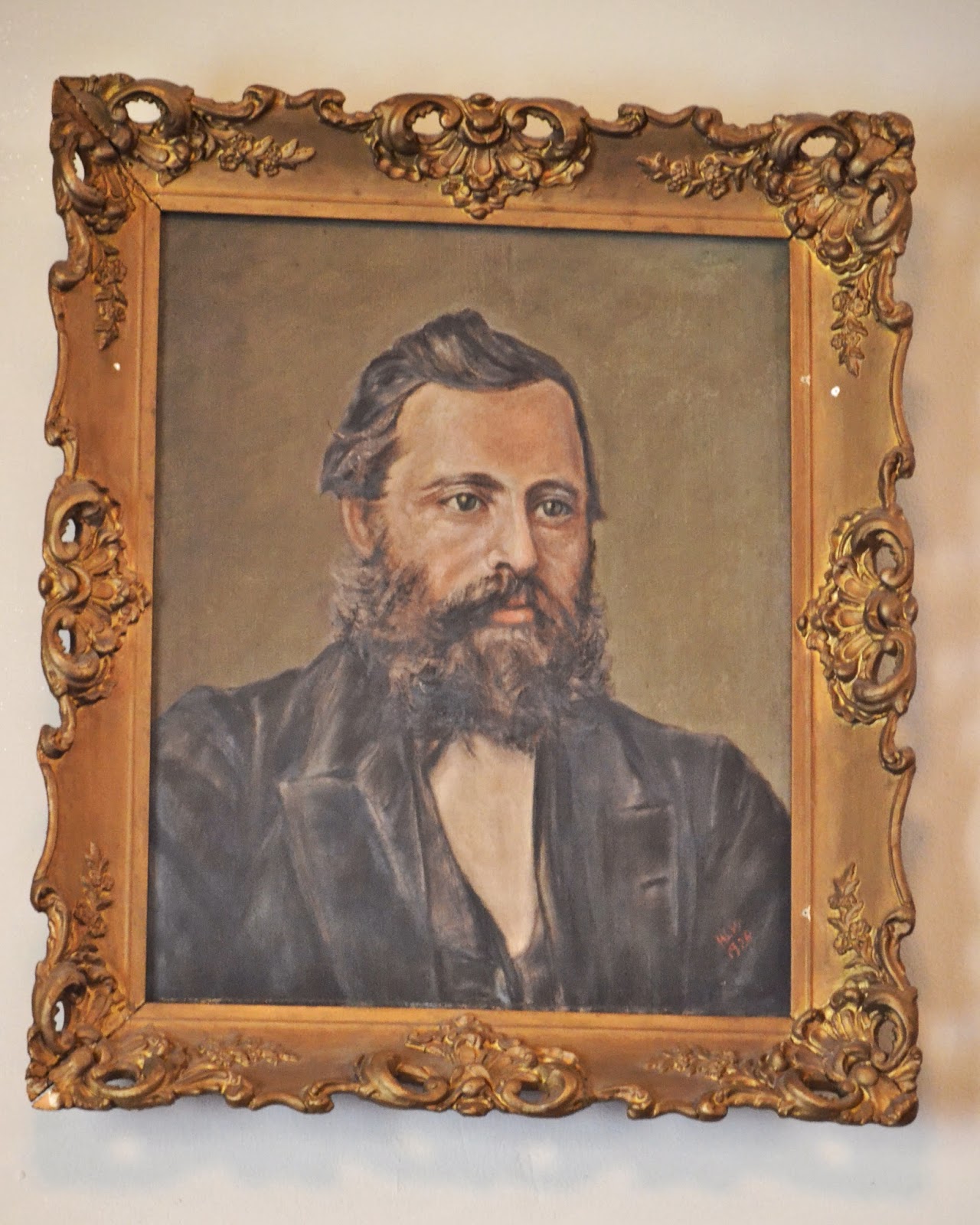
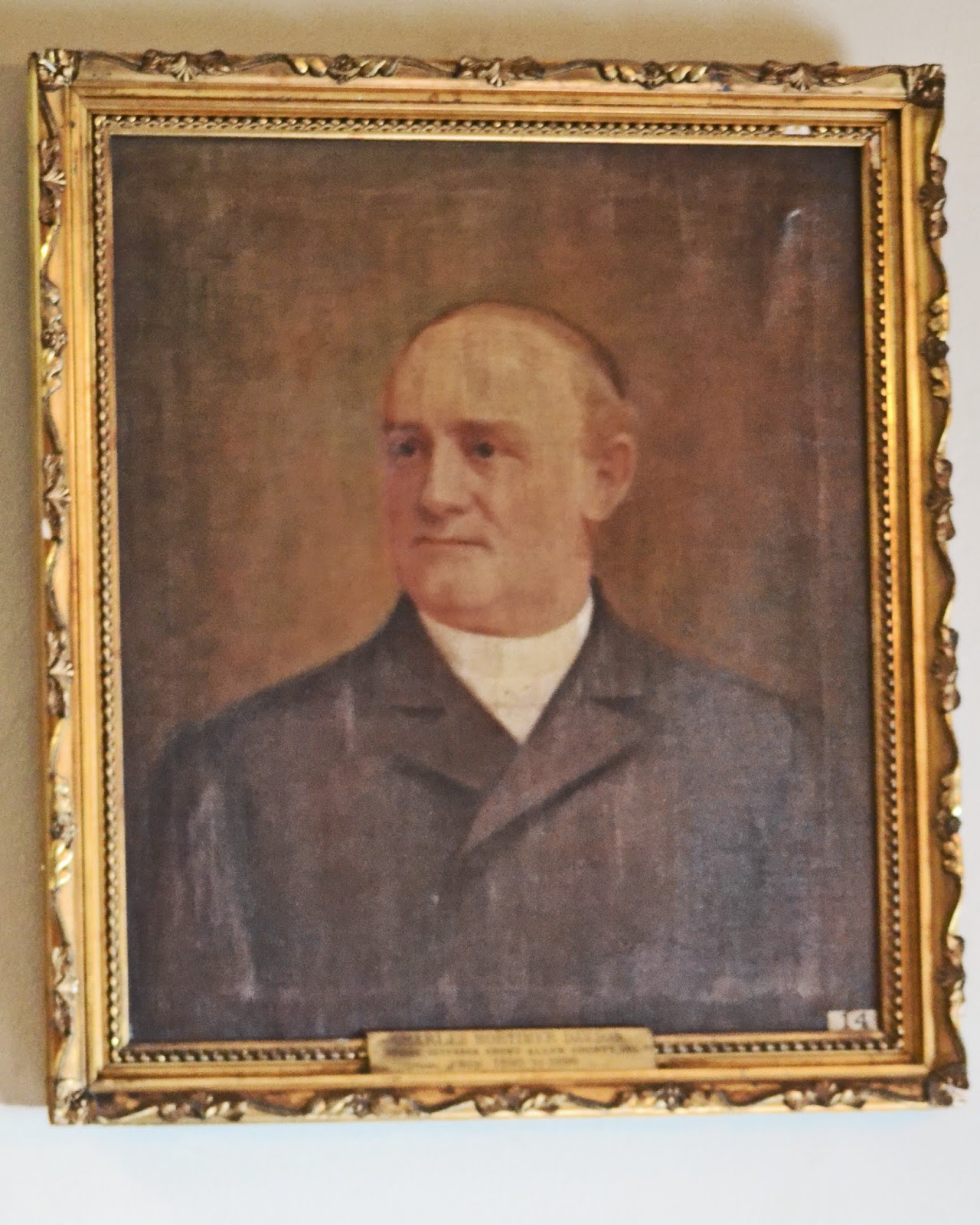
The Grand Staircase at the History Center is hung with the formal portraits of Fort Wayne citizens who could either afford to sit for a painter and have their portraits done or were prominent enough that someone was willing to make a portrait of them.

Although the faces probably aren’t familiar, some of the names are. There are portraits of Sam Hanna, Samuel Foster, and Major-General Henry Lawton. (For a very brief idea of why these men got to get places named after them, check out our blog from December- http://historycenterfw.blogspot.com/2013/12/why-is-he-so-important.html)

Here are the persons who are featured in our stairwell.

Moses Jenkinson- Moses Vail Jenkinson was the son of Joseph Jenkinson, a former Fort Wayne commander. Moses was an attorney and legislator. He was elected as a state representative and to the Indiana General Assembly.

Margaret S. Jenkinson- Wife of Moses. Not much else is known about her!


Stephen Bond Fleming- Fleming was a politician. He was in the Indiana State Senate from 1901-1915. Fleming was a delegate to the Democratic National Committee in 1908. He served as president of Holsum Bakery from 1938-1956. Fleming died at age 91 and is buried in the Catholic Cemetery. 


Dr. Park M. Leonard- Dr. Leonard served on the Board of Health in 1854. His portrait was painted by his granddaughter Harriet Wright. 


Samuel Foster- Sam was a “civic leader”. Basically, he was involved in a lot of different community organizations. He was president of the German-American National Bank, Lincoln National Life, and a member of the Indiana Centennial Committee where he was in charge of speakers. He is most remembered now for his park. Foster Park was the largest gift of park land to the city and was donated by Sam and his brother. Foster made money by being a banker and a shirtwaist manufacturer. (Shirtwaists were similar to blouses and you can see a great example in our exhibition gallery Allen County Innovation.)


Jack Griffin- Jack was a student at Yale when he unexpectedly died in a car crash. In his memory, his parents established a scholarship. 


Bert Griswold- Griswold was a historian, an author, and did newspaper cartoons and caricatures of important Fort Wayne citizens. His book The Pictorial History of Fort Wayne, Indiana is an excellent reference, used for information on many of the people in this post. One of his other books, Some Fort Wayne Phizes, has his drawings of prominent Fort Wayne citizens.


Charles Mortimer Dawson- Dawson was a well-known attorney and judge. He was a judge for the superior court. He was appointed prosecuting attorney of the 38th judicial district by the governor. 


Ross McCulloch- his grandfather was Hugh McCulloch. Ross was a member of many clothes and athletic activities. He lived in the McCulloch-Weatherhogg house, next to the History Center, now home of the United Way.


Major General Henry Lawton- Lawton was a great soldier. He fought in the Civil War (at Chickamunga and Shiloh, among other battles). After the Civil War he started to study law at Harvard, but when he got an appointment in the regular army, he became a career soldier. Lawton fought in the Indian Wars against Sioux and Apaches and was in the regiment that captured Geronimo. He then fought in the Spanish-American War alongside Teddy Roosevelt. After that, he fought in the Philippines, where he was killed. He is buried in Arlington Cemetery. (Yep, he was that important!) Lawton has a park in Fort Wayne named after him, and a statue. (Which is not in the park named for him!) 


Saturday’s News Sentinel described Teddy Roosevelt dedicating a statue of General Lawton in Indy- and here’s a photo:

This is a political cartoon featuring Lawton:

Brentwood Tolan- Tolan was the architect of the current courthouse, which is actually the 5th courthouse in Fort Wayne.


Samuel Hanna- Hanna was a judge. He was also a major landowner, involved in the railroad as well as in creating the canal. His family’s portrait is in the Fort Wayne Museum of Art. The History Center’s Digital Collections has the portrait (with family members identified) as well as some of the railroad concerns and shares from Hanna.


Yes, the portraits on the staircase are mostly of men. But these men made an impact on Fort Wayne history.

How are you going to make an impact on Fort Wayne history?