There’s a great little book entitled “Who Put That There” that can serve as a guide for exploring Fort Wayne’s history. The book was written by students at St. Jude Catholic School in 1998 with an Historic Preservation Grant from the Historic Landmarks Foundation of Indiana, the Indiana Humanities Council, and the National Endowment for the Humanities.
“Who Put that There: Outdoor Sculptures of Fort Wayne” is fun to look at—but it’s even more fun to actually visit the sculptures pictured in the book’s pages.
My son was visiting from NYC for Christmas and, as you well know, many of those who had left the city this year for the holiday had a challenge in returning at their appointed times. He was no exception so we had a few extra days together. Being with Mom and Dad for a week—when you’re 25 and single—doesn’t exactly make time fly so we set out one afternoon to do something besides watch television and eat.
Surprisingly enough, Chris, who has never really been “into history” but who loves art, got into the spirit as we drove around central Fort Wayne taking photos of some of the statues depicting the people who are a part of Fort Wayne’s history.
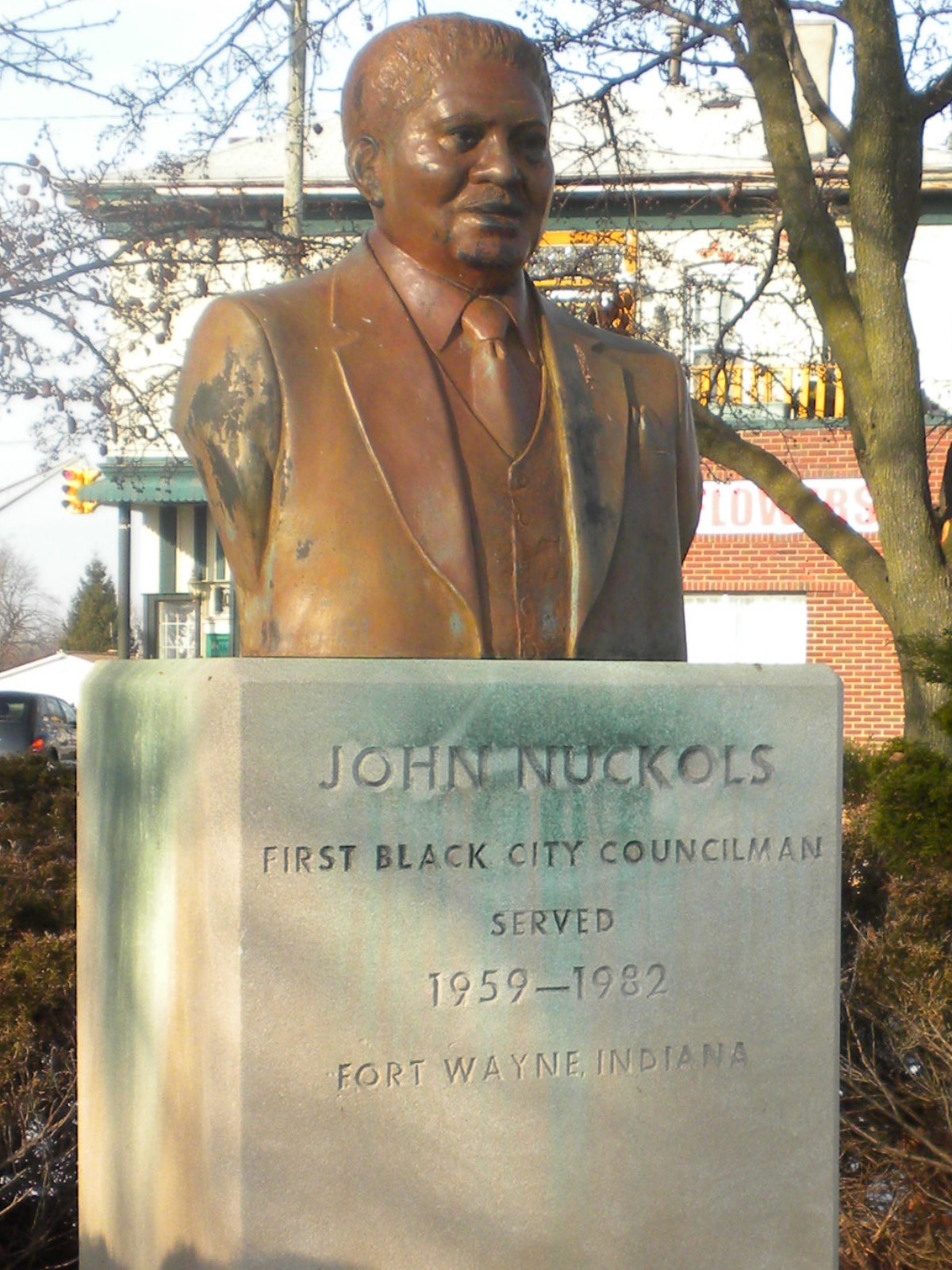
 Nuckols
Our first stop was at the corner of Harmar and Maumee Avenue. The bust of John Nuckols is in Nuckols Park, across the street from Carmichael Funeral Home. Nuckols was the first African American to serve on Fort Wayne’s City Council, which he did for 23 years, representing the first district.
According to the Fort Wayne Parks and Recreation web site, “Nuckols Park was purchased in 1876 from Fred Hayden for $4500 and was known as Hayden Park until 1986. The famous statue of General Anthony Wayne resided in Nuckols Park until it was relocated to its current Freimann Square location in 1973. Now, the park features a memorial of its namesake, John Nuckols, the first African-American city councilman.”
From Nuckols we drove over to the Gas House to take a shot of the statue of Charles Louis Centlivre.
 Centlivre
Centlivre was a Frenchman who moved to Fort Wayne and established a brewery at the north end of Spy Run.
The statue was a tribute from his employees, who had the creation installed on top of the Old Crown Brewery after their employer’s retirement.
IAS files indicate the sculpture was blown off the roof of the brewery by high winds in March 1964 and moved by Hall’s Restaurants in 1974 to its current location on the corner of Spy Run and Superior Streets.
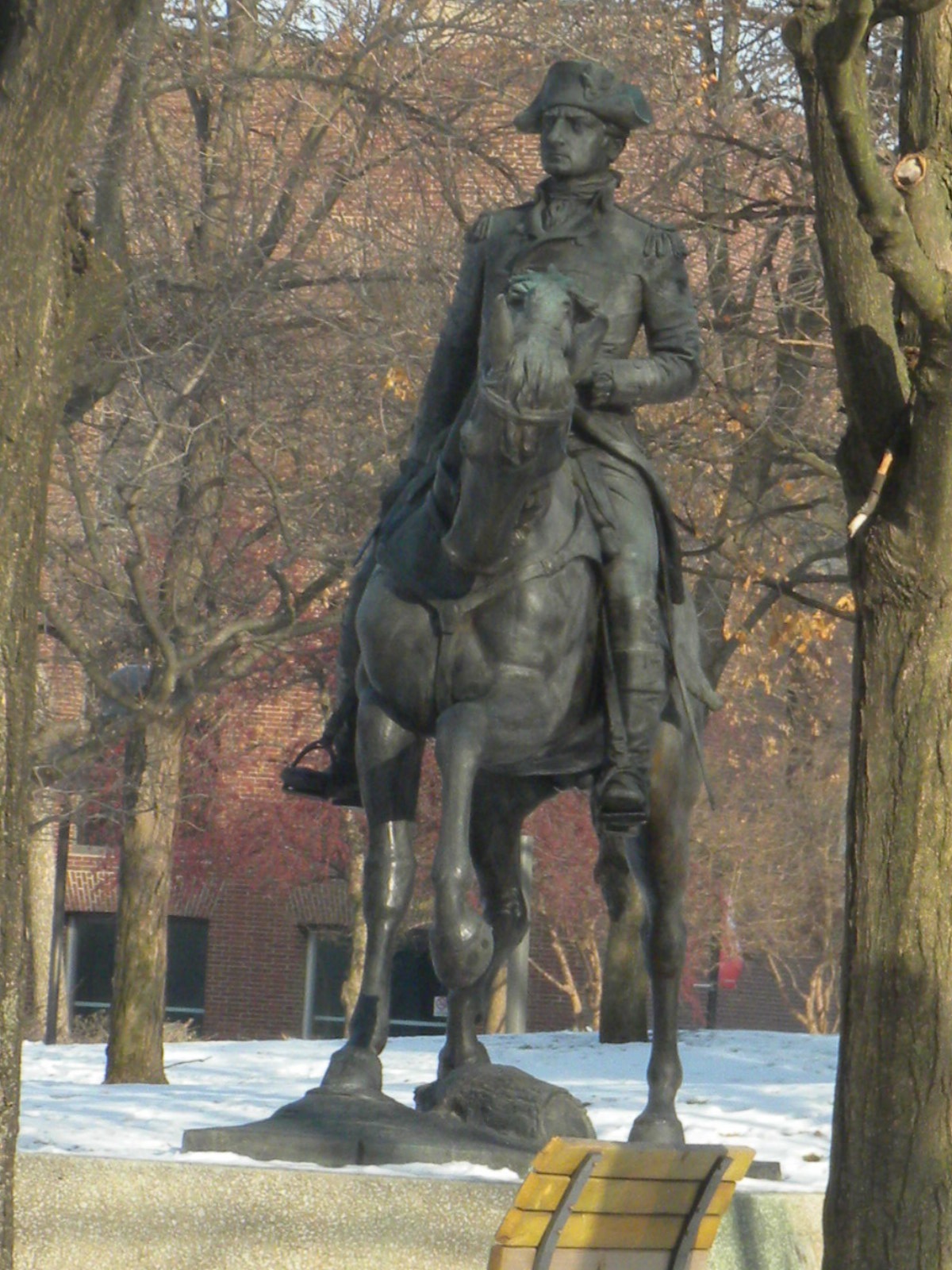
Exiting the Gas House parking lot, we drove under the railroad tracks into the parking area behind the Arts United Center. From there we connected to Clinton and took some photos of the Anthony Wayne statue in Freimann Square.
Wayne
It was a really cold day so we did not park the car to take a close look at this sculpture. But on a warmer day it’s well worth your time to walk through the square and take a closer look.
 Anthony Wayne – “Mad Anthony” – is the name sake of our city and a character from history worth further exploration. You can see his camp bed and other artifacts from his time in Indiana at the History Center.
From Clinton we drove over to Lake and Crescent to see the statue of Henry Lawton. This is one of my favorite Fort Wayne statues.
Lawton
Lawton was a Civil War hero and the first Fort Wayne native to win the Congressional Medal of Honor. The story of his life is truly interesting and the statue on the corner presides well over the neighborhood.
One of the many mysteries in Fort Wayne is why Lawton is in Lakeside Park, and not Lawton Park.
 Civil War Monument
We then ventured to Tennessee and parked long enough to take a photograph of the Civil War Monument in Lawton Park on Spy Run.
Headwaters Park and Lawton Park have a number of statues that you can view and a nice warm day is the best time to do this.
The Civil War Monument is the oldest public sculpture in Fort Wayne.
Headwaters Park is also home to a statue of Little Turtle and sculptures of the Hamilton sisters, one of whom wrote “Hamilton’s Mythology” that so many of us used as a text book in high school.
Lincoln
As we drove home, we went a little out of our way down to one of the Lincoln buildings on Harrison across from the Adair Federal Building. The statue there of Abraham Lincoln was created by Paul Manship and completed in 1932.
 Manship was a world-renowned sculptor who chose to portray Lincoln as a young man looking forward to fulfilling his dreams. Prior to his death in 1966, Manship produced a large number of coins and medals, including the JFK inaugural medal.
Heading out Washington we noted the statues of David Foster and Perry Randall where the street swoops around to become Jefferson. This is no place to slow down for a drive-by sighting but you can pull into Swinney Park to take a closer look at the statue of Foster. Foster is the founder of the Fort Wayne parks system. The inscription on his statue speaks to the importance of remembering and honoring those who shaped this city:
“He will live forever, not because of his military record, not by reason of his business career but by the laughter of the children, the strength of the youth, the joy of the middle-aged who shall live and love and prosper and know real happiness in the Greater Fort Wayne of Tomorrow, which is his dream come true.”
“Who Put That There” contains far more statues and sculptures than we featured here. But as you can see, you can map out a wonderful drive (or two) around our city to take a look at our history and perhaps spur yourself and your children to learn more about the people who made Fort Wayne what it is today.
You can also find more information about these and other historical figures at the Allen County Public Library, in books at the History Center, and on the internet. And watch this blog for more stories of Fort Wayne.