Showing posts with label Pennsylvania Railroad. Show all posts

Thursday, June 5, 2014

The Master Engineer of the Wabash and Erie Canal


by Tom Castaldi

Jesse Lynch Williams was the chief engineer for the Wabash and Erie Canal.  Born on May 6, 1807, near Danbury, N.C., Williams was the grandson of Judge John Lynch, the founder of Lynchburg, Va., and “Lynch Law” (which arose out of the judge’s summary treatment of Tories during the Revolution).  Jesse Williams’ parents, Jesse and Sarah, were members of the Society of Friends who moved to Cincinnati early in the ninetieth century and to Wayne County, Ind., by 1819.

 At the age of 17, in 1825, Williams was a rodman on a survey team laying the route for one of Ohio’s first canals, the Miami and Erie, which connected Cincinnati to the Maumee Valley.  In 1828, Williams met Susan Creighton, the daughter of Judge William Creighton, a congressman from Virginia during the War of 1812 and the first Secretary of State for Ohio.  She was also the granddaughter of David Meade, the subject of English novelist William Thackeray’s tale, The Virginians.  Susan and Jesse were married in Chillicothe, Ohio, where Williams accepted the assignment of completing the engineering for the northern leg of the Miami and Erie Canal.

Based on his Ohio engineering successes, Williams was employed by the Indiana Canal Commission to be the chief engineer for the Wabash and Erie Canal in 1832.  Two years later Williams was put in charge of all the canal projects in Indiana and in 1837 he was made the chief engineer for all Indiana improvement projects, including turnpikes, railroads and canals.

Williams earned the reputation for being a tireless worker, riding all day on horseback and spending evenings solving the numerous engineering problems of the canals, in addition to handling the account books, correspondence and reports to the legislature that the great project demanded.  He always rested on Sunday, however.  He was a staunch opponent of alcohol and an active member of the temperance movement.  Whenever he could, he would forbid contractors on the canal from issuing strong spirits, although crews often found ways around his prohibitions. He was also a devoted member of First Presbyterian Church in Fort Wayne. At age 26, he was elected to be an elder of his congregation.

Williams managed to stay above all the charges of corruption, venality, incompetence and theft that public works projects suffered during the 1840s as the canal’s financial woes deepened.  Indeed, in 1847, when the state of Indiana abandoned the canal and ceded it to a board of trustees, Williams was quickly chosen by the trustees “as a man of known and established character for experience and integrity” to be the chief engineer for the completion of the project. Williams held this position until 1876 when the canal at last failed and the United States court ordered it to be sold.

In 1854, Williams was appointed chief engineer for the Fort Wayne and Chicago Railroad, and when this company merged with the Pittsburg, Fort Wayne and Chicago Railroad in 1856, he became a trustee of the company (later to be known as the Pennsylvania Railroad).  His most important railroad position came in 1862, however, when President Abraham Lincoln appointed Williams to be a government director of the Union Pacific in the great transcontinental railway project. He was reappointed by successive presidents Andrew Johnson and Ulysses S. Grant and held the position until the Union Pacific met the Central Pacific at Promontory Point in 1869, completing the first railroad line across the west.  It was his job as a director of the project to oversee the establishment of the route, and so he spent many months combing the slopes and canyons of the eastern Rocky Mountains to produce the final report used by the railroad to lay its tracks.  Williams’ reports demonstrated how the project might save millions of dollars in construction costs and this led to investigations of the original proposals.  It revealed, in part, the great scandal known as “Credit Mobilier” involving the corruption of contractors and politicians as high up as the vice presidency.

Williams spent the last years of his life in Fort Wayne where he died in 1886 and was buried in Lindenwood Cemetery. 


Originally published in Fort Wayne Magazine, “Along the Heritage Trail with Tom Castaldi” – January/February 2005, No. 9, p.40.

.

Wednesday, April 16, 2014

Fort Wayne's Worst Train Wreck


by Nancy McCammon-Hansen

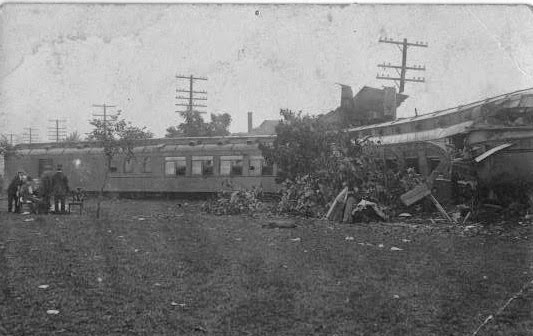
There’s nothing like an accident to bring out the gawkers and that certainly was true when Fort Wayne’s worst train wreck within the city limits occurred on August 13, 1911.


A speeding Pennsylvania Railroad passenger train, trying to make up for lost time, crashed into a freight train in Swinney Park. Three railroad workers were killed and 35 passengers and other crew members injured. (Some reports say four were killed and 30 injured.) The train was reportedly going about 50 miles an hour, traveling from Chicago to New York, when it left the track at a switch around 6:30 p.m. and crashed into the freight train. Two engines were pulling the passenger train and as they left the rails, they sideswiped the engine of the freight train.


“The baggage car, smoker, buffet, and two sleepers turned over in the ditch. Most of the injured were seated in the diner and smoker when the accident occurred,” according to the website www.historictornadoes.com/disasters/train-wrecks-accidents. Fortunately for the passengers, the train was composed of all-steel cars that survived the crash far better than “old-fashioned wood construction”. The engines of the passenger train were thrown down an embankment and the freight train’s engine “reared up over the trucks of the fliers (sic) engine”.


The information on the historictornadoes.com website was transcribed from The Washington Post District of Columbia 1911-08-14.

Other information in this blog post comes from Scott M. Bushnell’s book “Historic Photos of Fort Wayne”, which is for sale in our gift shop.

The photos come from postcards in the History Center’s collection.

Wednesday, December 18, 2013

The Pennsy Shops

by Tom Castaldi


The great expanse of the main post office once formed the central part of a large railroad operation commonly called the Pennsy Shops. These locomotive and railroad car shops extended east nearly three miles along the present-day Conrail tracks on the south side of the city.

For nearly half a century, from the Civil War until just past 1900, Fort Wayne was one of the most important railroad centers in the nation.

What made Fort Wayne a railroad center was the complex of shops where locomotives and cars were designed, built, tested and repaired or overhauled.

Here also labored hundreds of craftsmen who built some of the most luxurious passenger cars in the nation. The shops themselves were the central feature of all this activity.

Even before a train had ever been seen in Fort Wayne, Samuel Hanna in 1852 donated a parcel of land east of Clinton for the anticipated railroad shops. In 1853, John and Charles Cooper set up a blacksmith’s shop nearby, and in the next year Kentuckian Sion Bass bought the operation, only to sell it in 1857 to the newly formed Pittsburgh, Fort Wayne and Chicago Railroad (later the Pennsylvania Railroad).

This was the beginning of the Pennsy Shops. The shops grew rapidly, especially with the demands of the Civil War; in concert with the Bass Foundry located across the street, the railroad ships provided critical material help to the Union war effort.

After the Civil War, railways across the nation expanded greatly, and the demand for better engines and cars redoubled. In Fort Wayne the basic design of the Pullman Car was refined to produce the “Fort Wayne Silver Place Car.” Between 1867 and 1869, seven of these cars were built in Fort Wayne and at a  (then) staggering cost of $18,000 each.

Fort Wayne ceased to make locomotives after World War I, and much of the work at the Pennsy Shops was given to repair and overhaul. When locomotive rebuilding in Fort Wayne ended in 1933, the shops continued to build passenger cars. Still, the shops declined sharply after World War II.

Finally, in 1953 the last of the railroad operations closed, and by 1966 all the property had been abandoned; the roundhouse, the last vestige of the Pennsy Shops, was razed in 1984.


Originally published in Fort Wayne Magazine “Along the Heritage Trail with Tom Castaldi” – March 2007 No 30.

Allen County Historian Tom Castaldi is author of the Wabash & Erie Canal Notebook series; hosts “On the Heritage Trail,” which is broadcast at 6:35 a.m., 8:35 a.m. and 6:30 p.m. Mondays on WBOI, 89.1 FM; and “Historia Nostra” heard on WLYV-1450 AM and WRRO 89.9 FM. Enjoy his previously published columns on the History Center’s blog, “Our Stories,” at history centerfw.blogspot.com.