Friday, July 5, 2013

What kinds of museums are your favorite?


by Nancy McCammon-Hansen

We’ve had a number of discussions around the History Center in the past few months about how people view history. Some have seen our display of computers as not being historical. But it’s been one of the more popular temporary displays that have been mounted in the past couple of years because it allows parents, grandparents and their children and grandchildren to all talk about something they have used, but at different stages of its development.

Others have suggested that you can’t really know anything about history until you’re old. As someone who has loved history since elementary school…and who is now older (in body—not in spirit!) than she ever thought she’d be…I can honestly say you can know something about history at any age.  It’s also a great case for being a life-long learner.

We have also had some discussion about what sorts of museums we like…or don’t like. After touring the Indiana State Museum a couple of weeks ago, I’ve come to realize that I like history museums that focus on one person, such as a president, or one era, such as the 1960s & Woodstock.

The Indiana State Museum is right downtown in Indianapolis, within walking distance of many of the hotels. It’s next door to the Eiteljorg Museum of American Indians and Western Art. We didn’t take that one in—it was beastly hot and we’d walked enough for one day—but that one will definitely be on the list for another trip.


The state museum is currently featuring a Star Wars exhibit as one of their temporary exhibits. Quite frankly I didn’t understand why the state museum would feature Star Wars—other than the draw that Star Wars always solicits and the accompanying revenue. Much quieter and away from a lot of children was the temporary exhibit “The Lincolns: Five Generations of an American Family”, which runs through August 4. It’s sad to think that there are no more direct descendants of the man thought to be America’s greatest president. This exhibit is a lot more “folksy” than many you see of the Lincoln family and provides a look into their home life.

Natural History has never been “my thing” so we skipped that floor and went to level two of the museum which reflects the “Cultural History” of Indiana. For me, it was somewhat intimidating as there is so much information on this floor that to walk out without being on visual overload is nigh onto impossible. I was glad to see a picture of William Wells included in the displays (Wells being my favorite historical figure from Allen County) but the Ku Klux Klan display was more than a little disturbing. I realized I had never seen Klan “garb” on display anywhere. But it has inspired me to study the history of the Klan in Indiana a little more thoroughly.

Since coming to work at the History Center a little over three years ago, I’ve seen more reason to feed my addiction to museums because I can then write about them for this blog. I’ve learned a lot—primarily that a museum can no more be all things to all people than any other entity. We all have our likes and dislikes but you will ALWAYS learn something when you visit a museum. What are your favorite museums in this part of the country? Comment and let us know and we’ll feature them in a future blog post.

Wednesday, July 3, 2013

A Look at Some Swords in our Collection


by Nancy McCammon-Hansen

Our new software for archiving our collection of over 26,000 papers and artifacts has given us the opportunity as a staff to see some of the items that we’ve not seen in a few years and to do some further research into their history. When my friend Becca Brown inquired if there were any volunteer tasks she could perform while on break from William and Mary, I put her in touch with Karen Butler-Clary, our registrar. It is Karen’s job in part to photograph our collection and enter the pertinent information in the data base. Karen put Becca to work on swords since Becca loves to fence. And the rest, as they say, is history.

When I began researching this blog post on swords, I truly didn’t think there would be much material to share with you. A sword is simply a sharp instrument designed to defend oneself and spruce up a dress uniform if you’re in the military. At least that was what I thought. But the history of swords is massive and there is no way that we can cover everything there is to know about swords in this post. So I’ll just give you some highlights along with the photos and you can research away on your particular interest.

One of the first swords that Karen and Becca showed me is from the Revolutionary War.


Revolutionary War era sword

“During the era of George Washington, a gentlemen would no more leave his quarters without his sword then without his pants! Today, we cannot appreciate the personal bond a man had with his sword. To the civilian it was the symbol of his standing in a highly systemized Society. To a military officer it was an emblem of his rank and often a reward for gallantry, having been presented to him. To the common soldier or sailor it was the weapon of ‘last resort’. Swords that had family connections, having been borne in battle by other family members, held very significant emotional ties.” So said Donald N. Noran, in an article in the June/July 2004 edition of the Liberty Tree Newsletter.

We all know the story of Gen. Washington presenting swords to others as a reward for bravery or in thanks for some other act. “As you can read in the article Revolutionary War Presentation Swords, it wasn’t until 1786, three years after the war, that Congress was able to fulfill its promise to present 10 of the 15 dress swords they had awarded during the war. We believe that many of these swords had been captured from British or Hessian officers. It was a common practice for officers to have both a ceremonial sword and a ‘fighting or war’ sword. Therefore, a generous victor would permit a captured Officer to retain his sword - - which would have been his dress or ceremonial sword, quite often with the blade engraved with his name. The fighting sword was another matter. Another major contributing factor was that the colonies were not capable of producing quantities of high quality swords - - they were manufactured in Europe.”


The very end of the hilt...or button.

Swords are part of the ritual of the English coronation service and in Great Britain are stored in the tower of London along with the crown jewels. 
The engraving on this sword contains the word "Prince".


Naval sword's scabbard
Naval swords have a history all their own. “First cousin to the longer, lighter cavalry saber, the naval cutlass was designed for sea-fighting as the saber was adapted to land-battles. Because boarding actions were fought on the crowded decks of small vessels amid tangles of shrouds and splintered spars and struggling shipmates and foemen, Jack Tar's blade had to be short for easy control, and heavy enough to provide its own momentum in slashing. (Unlike the cavalry trooper's trusty saber, Jack's cutlass did not have the weight of a galloping horse behind it!) The cutlass had a straight or slightly-curved blade designed both for cutting and thrusting. A large, enclosed guard shielded the swordsman's hand.”


(Source: The Cutlass Carved its Niche in Our Navy's Annals by Richard Meckel, JO2, USNR, US Naval Air Station, Olathe, Kansas)


“The United States has never developed a series of military and naval swords truly national in design and manufacture. The swords of the colonial and Revolutionary War period were, with few exceptions, European in manufacture. Later, certain firms began to make swords on US government contracts. Most of these swords were designed along European lines.


The button on the Naval sword
Closeup of the chape...the tip of the scabbard


“There are a few distinctive characteristics of early American swords. One is the pommel which offered an excellent base for an eagle-head design. Many bore distinctive designs on the shield attached to the obverse side of the blade at the quillons. In some cases this shield bore designs of a mythological character relating to the art of war; in others it was decorated with a female figure representing America, surrounded by various emblems connected with American arms. These shields also bore the arms of America in a stereotyped form. The designs on the blades indicate that while many of the hilts were produced in America, most of the blades were of European manufacture. Many of these blades bear small floral and trophy designs of typical French or German origin, others have similar designs with the American shield as a center piece; and still others bear the complete arms of the United States in ornate style. These three types of blades are all contemporary with the use of the eagle's head on the pommel. This description is true of American swords up to about 1830. After that date American swords, in most cases, became more stereotyped and consequently lack much of their former artistic interest. About 1850 the Navy adopted the sword design which was continued with very little change down to the end of its use as a regular part of the dress uniform.”

(Source: United States. Chief of Naval Operations. Memo to Chief of Information, dated 1 October 1952. [copy located in the Navy Department Library's "Swords" vertical file])


Hilt of the Naval sword
One of the more ornate swords that we own is from RCU Knights of St John. The organization of the Knights of St. George, the Knights of St. Paul, the Knights of St. Louis and the Knights of St. John met in 1879 in Baltimore, Maryland and formed the Roman Catholic Union of the Knights of St. John. The order officially incorporated in New York State on May 6, 1886. The purpose of the order is to care for the spiritual, social and physical needs of members and neighbors.
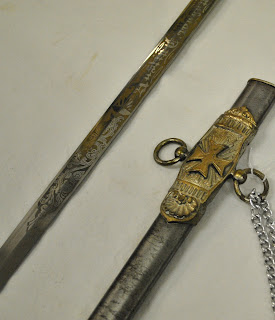
Sword and scabbard from the RCU Knights of St.  John
Hilt of the sword

Swords owned by members usually have their name etched on the opposite side of the swords blade that is engraved with "RCU Knights of St John" in script. 

There is a name etched on the sword.

Tuesday, July 2, 2013

I Love Fire Trucks!


by Nancy McCammon-Hansen

I love fire trucks. And when I say I love fire trucks, what I’m really saying is:


I LOVE FIRE TRUCKS!

 
One of Fort Wayne's fire trucks today.
Since I know I’m not alone in that love, I ventured over to the Fort Wayne Fire Fighters Museum the other day to take some photos and entice you to go visit too. The museum is at 226 West Washington, right next door to the downtown branch of the Allen County Public Library. Not only does the facility house artifacts from the history of the Fire Department, they also use the building to teach fire safety, something we all should learn.


George K. Bradley wrote a history of the fire department in 1964 for the Historical Society, detailing the history of the fire department from 1839 to the year of publication. We offer here some highlights of that history.

·       

  •  Most of the officials of Fort Wayne’s first city government –including the mayor—were members of Fire Company No. 1.

  • The first fire engine in Fort Wayne was purchased in 1839 and a fire company formed on August 30 of that year. The first fire house was built at the corner of Clinton and Main on the northeast corner, with the land being leased from W.G. Ewing for $6 per year for a three year period.

    Another of the older trucks
  • The Fire Department is the oldest unit of local government as it was created one year before Fort Wayne became a city in 1840.
    Circa 1839. Isn't she a beauty?

  • Early fires of note were on Columbia Street in April, 1841 for which the Fire Department was praised for its response in saving a great portion of downtown Fort Wayne, and at the Hanna and Work Tannery on June 1, 1848 in which the “wrath of the Fort Wayne Times descended upon the inefficiency of the fire company and its dilapidated engine.” It was time to buy a new fire truck. It arrived on December 7.

  • A fire the evening of May 20, 1849 destroyed fifteen buildings on Calhoun between Main and Columbia Streets. As a result of the efforts of residents and the recognized need for a backup fire engine, $268.00 was expended to repair “Fire Engine No. 1”. George Buchanan and Socrates Bacon did the work. New wooden buildings were also prohibited from being built in an area bounded by Main, Barr, Harrison and the canal. “This was truly a progressive step for the city.”

  • Large fires continued and one in particular brought more publicity to the fire department. “….most damaging of all, as far as the Fire Department was concerned, was the destruction of the Dawson Daily Times’ newspaper plant, on March 24. The fire would not have been so bad if the paper had been burned out of business. John Dawson did not quit easily and was soon back in print, with a special target for his editorial darts.”  Dawson had been highly critical of the Fire Department in the past.
  • The early city hall “was frequently on fire, but was saved each time by the assisting citizens”. This may explain, in part, the construction and design of the City Hall built in 1893, where the History Center is now housed.

  • The first fireman to die in the line of duty was Frederick Hilsman, who is buried in Lindenwood Cemetery. On June 7, 1871, “tragedy struck the fire department. A barrel of ‘rose oil’ in the Boltz Grocery on South Calhoun created a tragedy. This kerosene type mixture sat next to a pile of sacks that caught fire, or at least smoldered enough to call the fireman. Boltz, himself, was an active fireman and a member of the Alerts. …The fire was apparently out but Chief Mannix sent Joseph Aubry and Fredrick Hilsman, a torch bearer, into the basement to investigate. It was as deadly as searching for a gas leak with a match as the basement was filled with gas from the leaking barrel and there was no question about a fire. Fredrick Hilsman was trapped and suffocated in the smoke as he wandered through the basement seeking an exit. Aubry was injured and unconscious. He was pulled through a basement window by a fire hook. A series of explosions followed and both Mannix and Boltz were injured. A crowd gathered to watch the flames climb skyward and hindered the firemen. They were quite literally pushed back with singed hair and scorched faces by one of the firey (sic) explosions.”
    Badge of the Fort Wayne Fire Department

  • The Fire Department was not without strife in its early years and disagreements abounded over the purchase of a new engine. Volunteer companies resigned one by one and were replaced by semi-professional fire fighters. “By 1878, there were eight full-time firemen and seventeen paid ‘minute men’.”
  • The Bloomingdale Brewery was among famous fires when it burned on November 2, 1880. An arsonist started the $36,000 blaze but $500 worth of beer helped to check the fire when it “broke loose in the ruins”.

  • The biggest fire of the 19th century, in terms of dollars lost, was on November 23, 1888. Fort Wayne Electric Works, which later became part of the GE Plant, suffered a $207,000 loss.

  • Firemen earned $70 a month and had one day off per month. Most lived near their respective fire houses and could go home for “40 minute meals” and another half hour for “family duties”. Routine fire house duty included chores and exercise of the horses.

  • On May 3, 1908, the Aveline Hotel burned and the Preston truck, which had been purchased because the hotel was five stories tall, “made its last useful run to the building it was purchased to protect”. A short circuit in the basement elevator machinery was discovered at 3:30 in the morning. Most of the seventy guests asleep in the hotel escaped but some people did jump to their deaths, not waiting for the aerial ladders. Others were badly burned. In total, 11 people died.
  • Horses that pulled fire engines were well trained and also neighborhood pets. Three of the better known horses were named Sam, Pete and Max.

  • The Fort Wayne Fire Department became “motorized” around 1912 and the last official horse drawn run occurred on October 6, 1920.

  • The 1930s saw less tax money for new equipment and so the department purchased an “International Harvester truck chassis and a 1000 g.p.m. Northern Rotary pump” and turned them over to the Master Mechanic, who built a fire truck. “On May 9, 1938, the Chief demonstrated his brand new, home-built, pumper to the Board of Safety.” The fire department built a second unit and ‘used some of the parts and equipment recovered from two old Seagrave pumpers scrapped at the same time’.”

  •  “…The department’s construction program was widely hailed and followed with interest by fire officials in many cities. The program ended abruptly with the outbreak of war. Had it continued, some interesting equipment might have resulted, as at least one aerial ladder truck was planned. Fort Wayne entered the war period with an up-to-date fire department and once again, one of the most modern in the country.”

  • In 1951, the Fire Prevention Bureau of the Fort Wayne Fire Department won three national awards in a competition among 3500 principal cities. The awards were for: Finest Fire Prevention Program in the United States; Best Radio Presentation of Fire Prevention (awarded to WOWO); and Best Industrial Fire Prevention Program (awarded to Fort Wayne works of General Electric).

You can learn more about the history of the Fort Wayne Fire Department by reading the book “Fort Wayne’s Fire Department 1839-1964” by George K. Bradley, available for sale at the Firefighter’s Museum. You can also find information about the fire department in the Genealogy Department of the Allen County Public Library. http://archive.org/details/historyoffortway03webe


And do visit the Firefighters Museum. As the child of a former volunteer firefighter in my hometown of Kearney, NE, I can tell you that anyone who chooses to fight fires either as a volunteer or as a paid member of the department has chosen one of the most difficult of tasks. As Mayor Harold Zeis said in his introduction to Bradley’s book:


“Good fire protection does not come easily or cheaply. The fireman is prepared, at any moment, to risk life and limb in protection of the taxpayer and his property. We can ill afford to have anything less than the best firemen and fire-fighting equipment. None of us can know when he may suddenly and unexpectedly have to depend on the efforts of our Fire Department to preserve his home or the lives of his loved ones.”


And on a final note: Amy Biggs became the first female fire chief in Fort Wayne on June 30, 2012. According to the city’s web site, Fort Wayne has the second largest fire department in Indiana. Biggs oversees fire protection for the 110 square miles of the City of Fort Wayne and manages a department of more than 380 firefighters, posted at 18 fire stations.  

I wasn't standing "square on" with this sign, but it's being included here because it's a very interesting explanation of how firefighters got their badges: