Thursday, January 6, 2011

Martin Luther King's Visit to Fort Wayne

On the third Monday in January we celebrate Martin Luther King's birthday and honor his many contributions to building a better world. As an orator and champion of civil rights and non-violence, Dr. King is most often remembered for his "I Have a Dream" speech delivered during the March on Washington at the end of August 1963. Few of us know that a couple of months earlier on June 5, Martin Luther King spoke here in Fort Wayne at the Scottish Rite. His words touched the hearts of thousands gathered to hear him. Front page publicity in The Journal Gazette made it obvious that this black preacher from the South was someone to be taken seriously.

King was only 34 years old when he visited Fort Wayne, but he had already built a national reputation. For six years he had been leading a coalition of African American ministers known as the Southern Christian Leadership Conference for the purpose of ending widespread racial segregation. Months before his appearance at the Scottish Rite, King had led non-violent boycotts, sit ins, and marches in Birmingham, Alabama. National television cameras had captured the police brutality used against demonstrators, igniting widespread moral outrage. Only recently, Dr. King had written his now famous "Letter from Birmingham Jail" explaining to fellow ministers why the movement for black civil rights could no longer wait.

Dr. King's appearance in Fort Wayne was arranged by a group of church and civic leaders led by the African American Frontiers Club. Dr. John Meister, pastor of First Presbyterian Church, introduced him as "a glorious disturber of people and the peace."

Fortunately for us today, much of Dr. King's speech was recorded by Wesley Bashore, a journalist writing for The Journal Gazette. We can imagine being present in the packed auditorium on that warm evening moved by the passion and immediacy of Dr. King's words.

"There come a time when a people get tired of injustice, oppression, exploitation. We want to be free."

"Segregation is the new form of slavery covered with the niceties of civilizations."

"The Negro today will suffer, sacrifice, even die to be free."

"Some say slow up. You're moving too fast., We can't - we love America too much. We're through with gradualism, tokenism, see-how-far-you've come-ism."

"We have learned to stand up against the evil system - and still not hate in the process. We have discovered that love works miracles."

In an interview with Wesey Bashore, King made it clear that segregation was not only a problem in the South. De facto segregation "in such cities as this [Fort Wayne] can be just as damaging as the prevalent legal segregation of the South," he said.

A year after his visit to Fort Wayne, Dr. King was vaulted to international fame by being awarded the Nobel Peace Prize. Congress under President Lyndon B. Johnson would pass the Civil Rights Act of 1964. Years of struggles to fulfill the promises of a more equal society would long continue. Few would remember Dr. King's speech here at the Scottish Rite, one of thousands he made during his travels across the country before his tragic assasination in 1968. Still, at this time when we celebrate his life, it is appropriate to recall our local connection. As he did in so many communiities, here in Fort Wayne Dr. King kindled hope and ignited a movement for social justice that wouldn't be stopped.

The Journal-Gazette June 5, 1963 article covering Dr. King's visit is available on microfilm at the Allen County Public Library.
by Peggy Seigel

Monday, January 3, 2011

Who Put That There?

There’s a great little book entitled “Who Put That There” that can serve as a guide for exploring Fort Wayne’s history. The book was written by students at St. Jude Catholic School in 1998 with an Historic Preservation Grant from the Historic Landmarks Foundation of Indiana, the Indiana Humanities Council, and the National Endowment for the Humanities.


“Who Put that There: Outdoor Sculptures of Fort Wayne” is fun to look at—but it’s even more fun to actually visit the sculptures pictured in the book’s pages.


My son was visiting from NYC for Christmas and, as you well know, many of those who had left the city this year for the holiday had a challenge in returning at their appointed times. He was no exception so we had a few extra days together. Being with Mom and Dad for a week—when you’re 25 and single—doesn’t exactly make time fly so we set out one afternoon to do something besides watch television and eat.


Surprisingly enough, Chris, who has never really been “into history” but who loves art, got into the spirit as we drove around central Fort Wayne taking photos of some of the statues depicting the people who are a part of Fort Wayne’s history.


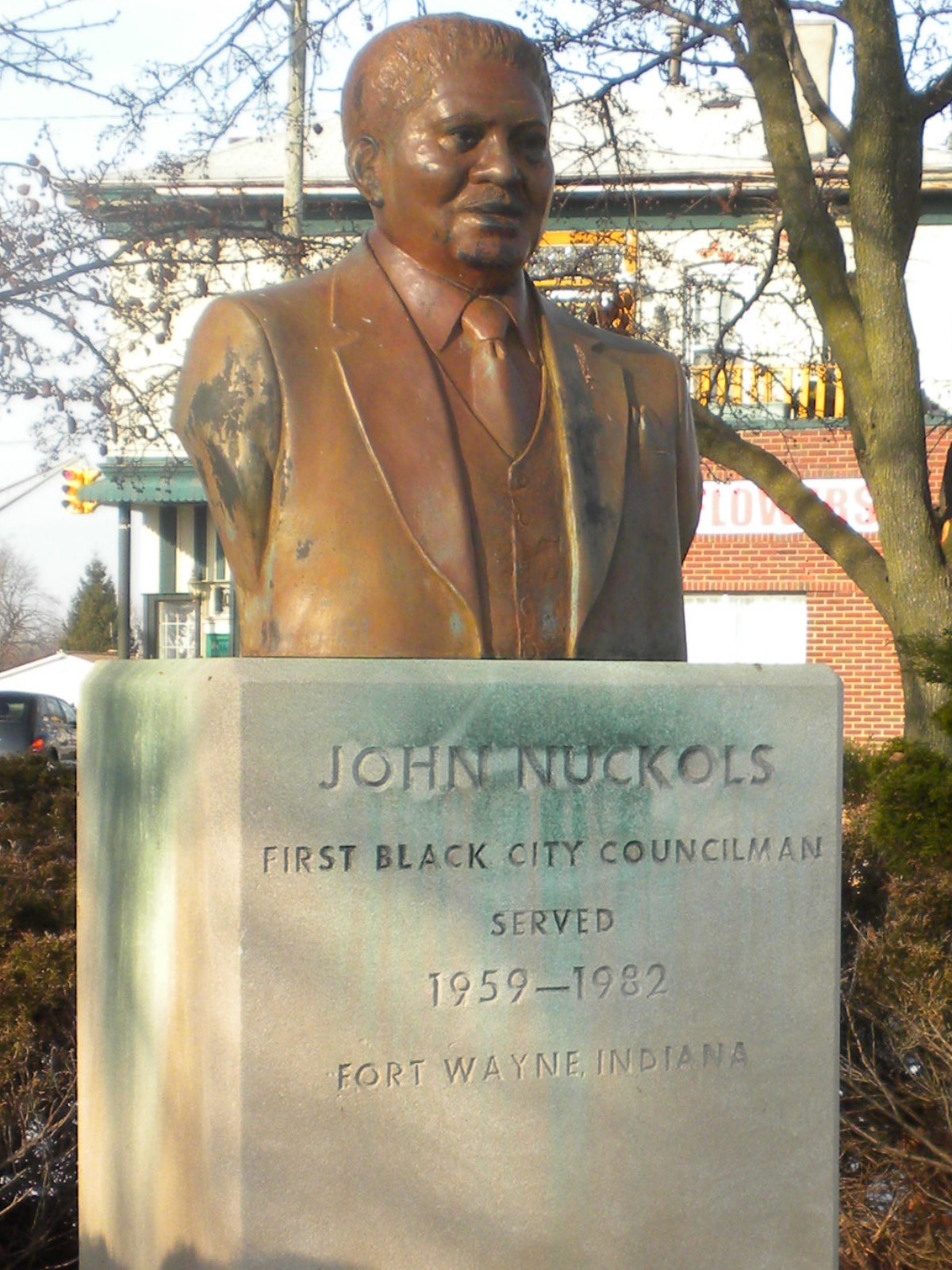
Nuckols

Our first stop was at the corner of Harmar and Maumee Avenue. The bust of John Nuckols is in Nuckols Park, across the street from Carmichael Funeral Home. Nuckols was the first African American to serve on Fort Wayne’s City Council, which he did for 23 years, representing the first district.


According to the Fort Wayne Parks and Recreation web site, “Nuckols Park was purchased in 1876 from Fred Hayden for $4500 and was known as Hayden Park until 1986. The famous statue of General Anthony Wayne resided in Nuckols Park until it was relocated to its current Freimann Square location in 1973. Now, the park features a memorial of its namesake, John Nuckols, the first African-American city councilman.”


From Nuckols we drove over to the Gas House to take a shot of the statue of Charles Louis Centlivre.

Centlivre

Centlivre was a Frenchman who moved to Fort Wayne and established a brewery at the north end of Spy Run.

The statue was a tribute from his employees, who had the creation installed on top of the Old Crown Brewery after their employer’s retirement.


IAS files indicate the sculpture was blown off the roof of the brewery by high winds in March 1964 and moved by Hall’s Restaurants in 1974 to its current location on the corner of Spy Run and Superior Streets.


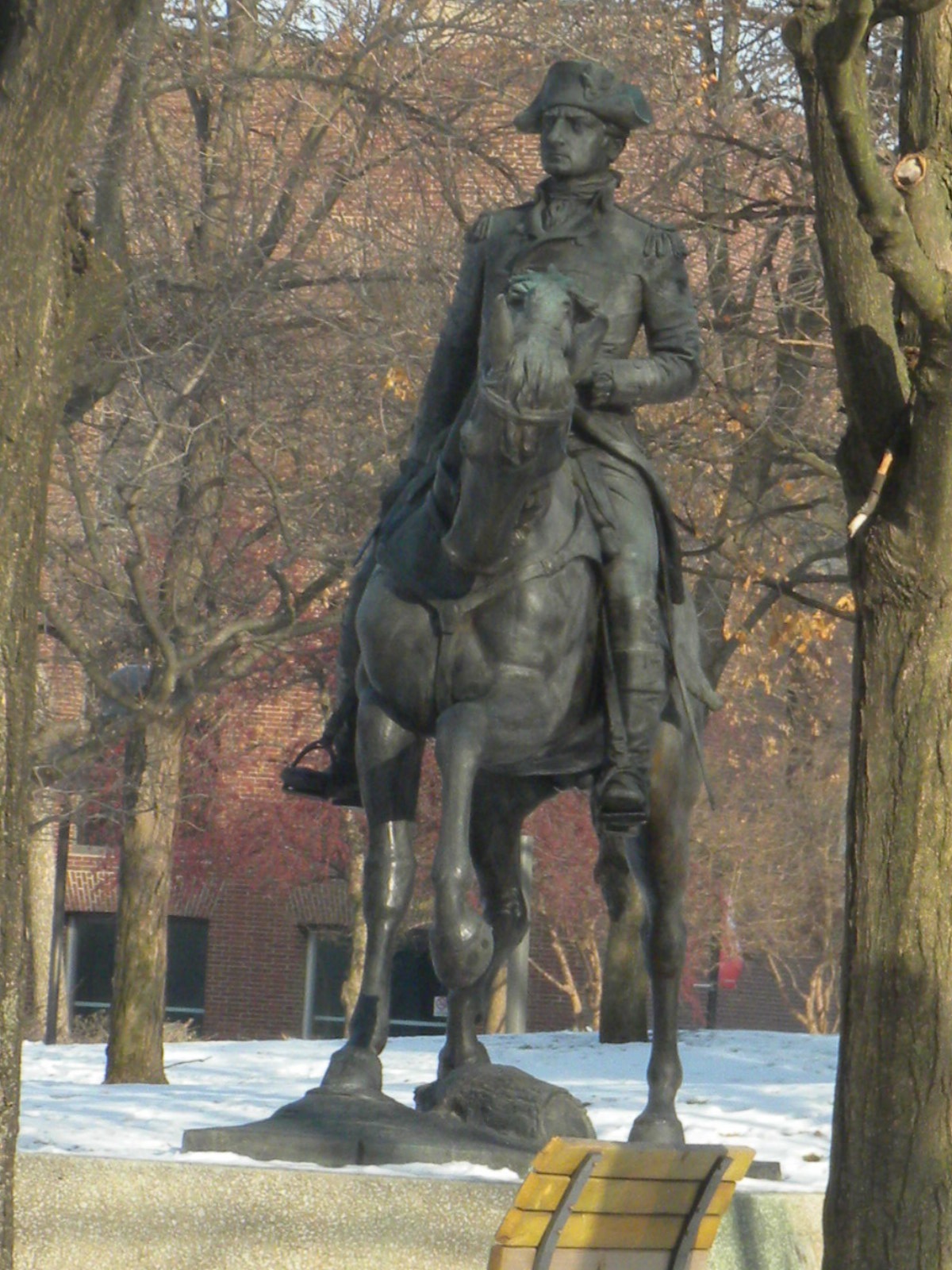
Exiting the Gas House parking lot, we drove under the railroad tracks into the parking area behind the Arts United Center. From there we connected to Clinton and took some photos of the Anthony Wayne statue in Freimann Square.

Wayne

It was a really cold day so we did not park the car to take a close look at this sculpture. But on a warmer day it’s well worth your time to walk through the square and take a closer look.


Anthony Wayne – “Mad Anthony” – is the name sake of our city and a character from history worth further exploration. You can see his camp bed and other artifacts from his time in Indiana at the History Center.


From Clinton we drove over to Lake and Crescent to see the statue of Henry Lawton. This is one of my favorite Fort Wayne statues.

Lawton

Lawton was a Civil War hero and the first Fort Wayne native to win the Congressional Medal of Honor. The story of his life is truly interesting and the statue on the corner presides well over the neighborhood.

One of the many mysteries in Fort Wayne is why Lawton is in Lakeside Park, and not Lawton Park.

Civil War Monument


We then ventured to Tennessee and parked long enough to take a photograph of the Civil War Monument in Lawton Park on Spy Run.

Headwaters Park and Lawton Park have a number of statues that you can view and a nice warm day is the best time to do this.

The Civil War Monument is the oldest public sculpture in Fort Wayne.


Headwaters Park is also home to a statue of Little Turtle and sculptures of the Hamilton sisters, one of whom wrote “Hamilton’s Mythology” that so many of us used as a text book in high school.

Lincoln


As we drove home, we went a little out of our way down to one of the Lincoln buildings on Harrison across from the Adair Federal Building. The statue there of Abraham Lincoln was created by Paul Manship and completed in 1932.

Manship was a world-renowned sculptor who chose to portray Lincoln as a young man looking forward to fulfilling his dreams. Prior to his death in 1966, Manship produced a large number of coins and medals, including the JFK inaugural medal.


Heading out Washington we noted the statues of David Foster and Perry Randall where the street swoops around to become Jefferson. This is no place to slow down for a drive-by sighting but you can pull into Swinney Park to take a closer look at the statue of Foster. Foster is the founder of the Fort Wayne parks system. The inscription on his statue speaks to the importance of remembering and honoring those who shaped this city:


“He will live forever, not because of his military record, not by reason of his business career but by the laughter of the children, the strength of the youth, the joy of the middle-aged who shall live and love and prosper and know real happiness in the Greater Fort Wayne of Tomorrow, which is his dream come true.”


“Who Put That There” contains far more statues and sculptures than we featured here. But as you can see, you can map out a wonderful drive (or two) around our city to take a look at our history and perhaps spur yourself and your children to learn more about the people who made Fort Wayne what it is today.


You can also find more information about these and other historical figures at the Allen County Public Library, in books at the History Center, and on the internet. And watch this blog for more stories of Fort Wayne.

Friday, December 10, 2010

A Charles Beecher Christmas

Travel back to December Sundays during the mid 1840s. In the recently completed Second Presbyterian Church on West Berry Street, the Rev. Charles Beecher jovially strolls before his congregation playing the violin. Simultaneously, he conducts the church choir and congregants in one Christmas carol after another. When he steps up to preach, no one falls asleep. Packed together in this small church are followers of at least five different faith traditions representing a broad cross section of Fort Wayne society.

Charles Beecher's six years in Fort Wayne, 1844 to 1850, were at the beginning of his long careeer as a maverick minister and champion of social justice. The ninth of eleven children born to the Rev. Lyman Beecher, Charles had entered the ministry reluctantly. His father was president of Lane Theological Seminary in Cincinnati and was one of the foremost Presbyterian leaders of his day. Charles's education at the best New England prep schools and at Bowdoin College, however, had nurtured his love for poetry and music. He tried to avoid the ecclesiastical warfare and antislavery debates led by his father and his scholarly older brother Edward.

By his late twenties, married and a father, Charles agreed to the family plan to install him in Fort Wayne at his own church. According to the scheme of his older brother Henry Ward, then serving a church in Indianapolis, Charles would take the recently vacated pulpit of Fort Wayne's First Presbyterian Church on behalf of the Presbyterian faction championed by their father known as New School. The entrenched Presbyterian hierearchy, however, would hear none of this. Shortly before the Beechers arrived in Fort Wayne, a theologian from Hanover College representing the Old School faction won First Presbyterian's pulpit. Charles Beecher's future as an embattled minister and social reformer was thus launched.

Despite intense efforts, Henry Ward and Lyman Beecher were only able to recruit six members for Charles's new church. On Sunday mornings Charles rode his horse out to neighboring villages. On Sunday evenings he conducted services in the musty Allen County Courthouse. By 1845, only one year later, trustees and church friends helped Charles build their new church home. In addition to two Sunday services, Charles continued his ministry in at least four rural areas. Members from his church led Sunday school classes in these areas as well.

Reflecting his discomfort with religious conflicts, Charles preached tolerance and social justice. One of his most remembered sermons caused fellow Presbyterian ministers to view him as "unsound in the faith" because he stressed that there was more than one way of looking at fundamental religious truths. "The only unity that ever will be attained before the Resurrection of the Just, on earth, will be a unity of thinking differently, in love." Charles led his congregation in ministering to the poor in Fort Wayne. He organized a popular singing school, Bible classes, and discussion groups. He spoke out against the sin of slavery and against the unjust treatment of African Americans in our so-called free North. He likely supported the secret work of the underground railroad. Along with his strong moral convictions, he was quick to find humor in life. He was known for his storytelling.

In the spring of 1850 Charles told his congregation that he and his family, now including four children, were returning to New England for the summer. Sickness and poverty had taken their toll on this popular and "original" minister and his family. By the end of the summer, Charles made it known that they would not be returning. Reluctantly, members of Second Presbyterian Church gave up plans to ordain Charles as their first permanent minister.

Within a year after leaving Fort Wayne, Charles was recognized as a national leader in the growing anti-slavery struggle. His sermon against the Fugitive Slave Bill of 1850 and a long tract arguing against Biblical sanctions of slavery were circulated by the American Anti Slavery Society. He helped his sister Harriet Beecher Stowe describe scenes of slavery he had earlier witnessed in Louisiana that became part of her international best seller "Uncle Tom's Cabin." Charles then accompanied Harriet on a triumphal European tour. For decades, despite accusations of heresy, Charles championed religious tolerance.

While some Fort Wayne residents criticized Charles for going against popular opinions of the day, he was fondly remembered by many who knew him. His exuberant expressions of love through music and words during the divisive years leading up to the Civil War had touched their hearts. Today as we face other forms of war and injustice, particularly during this dark season, it is good to remember this truly remarkable "original."

Thursday, December 2, 2010

Forgotten Pronunciations

Recently while reading John F. Meginness, The Lost Sister of Wyoming searching for places and dates about Frances Slocum, I ran into a recollections piece by Horace P. Biddle. A highly regarded jurist, Biddle was born on March 24, 1811 in Fairfield County, Ohio, later settling in Indiana. He had studied law as a young man and became so good at it that in 1874 he earned a seat on the bench of the Indiana Supreme Court. Retiring in 1881, he began devoting much of his time to literature and music and in fact authored several books mostly on poetry. Meginness had a great respect for the old Judge and included Biddle’s recollection of notable people of his day.

That brings us around to the point of this posting. We in Indiana and especially in Allen County have long admired the Miami Civil Chief Jean Baptiste Richardville. Many are familiar with the chief’s history, that his father was a Frenchman, that his mother Taw-cum-wah brought their son up in the Miami culture, that his house still stands on Fort Wayne’s south side along Bluffton Road and that most people pronounce the name as “Richard Ville.” Even though from time to time we are corrected by those who would hold to purer articulation, we continue to use the familiar “Richard Ville” cognomen. Maybe it’s because we reason that at times even others’ suggestions don’t agree, so most of us are content to stick with our reliable “Richard Ville” and go on our way. We also enjoy the stories handed down orally and written about this famous man.

Judge Biddle makes it plain on page 197 that the name is pronounced “Roosheville.” He then proceeds to give this anecdote that makes the old Miami so interesting.

It seems that William G. Ewing had a disagreement with a French Indian trader named Mr. Berthelette who was an intimate friend of Chief Richardville. Whatever the squabble, Berthelette was intensely angry with Ewing and made a visit to Chief “Roosheville.” No sooner had the two greeted one another Berthelette was asking to borrow the Chief’s pistols. When Richardville inquired why such a request, Mr. Barthelette made it clear that he wanted to kill Mr. Ewing.

Judge Biddle recreated the scene quoting the chief, “Ah, oui, you shall have my pistol, Mr. Bar-te-lette; but come in and eat some dinner with me.’ After dinner was over Berthelette became very restless. The chief said nothing more about the pistols. Berthelette addressed him: ‘Chief, now for the pistols.’ ‘ Ah, oui; I get you dem pistol.’ The chief retired a few minutes, and came back with two bottles of wine. ‘Here, Mr. Bar-te-lette, my pistol – handing him the two bottles of wine – ‘but take care, now, you (don’t) shoot yourself.’”

Such is the nature of the great civil chief of the Miami who continues to bear the name we may not pronounce to the satisfaction of everyone. However, decisions such as the one he made with a couple bottles of wine demonstrate a wisdom that his people respected and formed the legacy of a wise old leader we can all admire.

Tuesday, November 30, 2010

A Brief History of Gingerbread

Fascinating is the word that best describes the lore of that delectable holiday treat we call gingerbread. Ginger root has been treasured from antiquity for seasoning food and for medicinal purposes. About 800BC, the Greeks invented gingerbread. Called “melitates,” it was a solid block made of honey combined with flour, ginger, and spices.

By the 14th century, Germans had refined the lump into fanciful shapes using carved wooden molds. This idea spread into England where Queen Elizabeth I is credited with inventing the first gingerbread man. The first gingerbread guilds appeared in Germany in the 16th century and as the popularity of gingerbread grew, the cry of the gingerbread hawker was heard in the streets. In the early 17th century, the French and English added eggs, flour, and honey. When molasses from North America became available to the English, it was often used as sweetening.

Early settlers to the American Colonies brought their cravings for gingerbread with them and gingerbread assumed a variety of roles in Colonial lifestyles. Traditionally, the first Tuesday in June was “Muster Day” in the Colonies. The citizenry would turn out to view the local militia train while the ladies would serve gingerbread as the treat for the day. Gingerbread was also used as a bribe to voters to elect certain candidates to the House of Burgesses.

In some of the Colonies, on December 21st, the schoolboys would “bar the master,” arriving to school early in the morning to ensure the schoolmaster could not enter. After some half hearted pleading and the offering of gingerbread as ransom, the teacher would give up and declare a holiday over Christmas. At New Years, parents would encourage their children to eat a gingerbread hornbook so that they would be smart in the new year for having eaten all the knowledge of the hornbook.

Throughout the 19th and early 20th centuries, as throngs of German immigrants found their home in Fort Wayne, merging with the existing English population, our community’s ancestors solidified the traditional celebration of gingerbread, which has manifested itself in the annual Festival of Gingerbread for 25 years. Join us at the History Center through Sunday, December 12th as we celebrate the Silver Anniversary of the Festival of Gingerbread.

Friday, November 19, 2010

Quest Club's New Book


In December 1911, a group of local businessmen lamented the rapid changes taking place in the business world and their own limitations in keeping up with the latest management techniques. There were no MBA programs at the time, and few business schools of any kind. In order to stay competitive, they sought a way of improving their knowledge of sales techniques, marketing, employee management, and ways of streamlining the management of their firms. To achieve these goals, they organized a new club, known as the Quest Club, where they could meet to hear lectures, both from outside experts as well as among their own membership. They also organized their own circulating library of business and economic books. The club model was similar to that of the lyceum, which had been popular across America in the mid-19th century, where gentlemen read books and listened to lectures as a means of self improvement.


The club became popular. Many local business leaders joined (by invitation only), and eventually the membership expanded to include a variety of other professions, including lawyers, architects, clergy, physicians, and educators. With the expanding membership came more variety in the papers presented (which were now assigned to the members to present). Club members heard papers on current events, literature, the arts, and the physical and social sciences. Over the years the club discussed a variety of issues of importance to the city, including elevating the railroad tracks, establishing the Fine Arts Foundation, and creating a new university that eventually became Indiana University-Purdue University at Fort Wayne. The club voted to include women as members in 1993.


Today, the club continues to adhere to its founding principles of life-long learning, a love of research, providing a forum for wide-ranging discussions on controversial issues, and civil discourse. As the club approaches its centennial, it has published its second book, Quest Club: The First 100 Years. The book includes a variety of great essays from its past and covers a wide range of subjects: poetry, civil religion, Kurt Vonnegut, Stephen Sondheim, the mystery of Stradivarius violins, jazz, cosmology, and Lincoln's Second Inaugural Address, to name just a few. The book's Foreword was written by Allen Steere, a long-time executive with the Lincoln National Life Insurance Company who passed away recently at age 102.


The book is available at the History Center's Gift Shop for $25. The eclectic mix of essays symbolizes the diversity of the club's focus over its past century and is itself a great souvenir of Fort Wayne history.


Thursday, October 28, 2010

A Daguerreotype of the Fort


The History Center has a wonderful collection of historical images. Because the society was founded in 1921, it acquired many invaluable artifacts from the children and grandchildren of Fort Wayne's earliest pioneers. Its photographic collection is full of treasures, and one item in particular of special value is a daguerreotype of a blockhouse from the old 1816-era fort, actually one of two daguerreotypes of it in the collection.


In the fall of 1852, Charles C. Stevens stopped by the crumbling building and photographed his friends seated in front. Located on Main Street near the present site of Fire Station No. 1, the old fort had been abandoned by the U. S. Army garrison in 1819. During the ensuing years several families lived in the structures, including, it is said, some Irish immigrants, but the structures soon became derelict. By the 1850s, little of the fort was left. The pallisades were long gone, and scavengers had taken for souvenirs many of the original timbers. Local residents used other pieces apparently as building mateirals and beams in local houses, including the Merchant Huxford house on Spy Run Avenue, which is still standing.


Little is known about Stevens. "Craig's Daguerrian Directory" indicates that he advertised himself as a daguerrian between June and November 1852 in rooms at the residence of John Fairfield on Main Street. In his book, "Pictorial History of Fort Wayne," Bert Griswold quoted Mrs. Adam Link, who owned the daguerreotype in 1917, and cited her account of the picture. Stevens, she said, came from Kennebunkport, Maine, as a guest of Hannah Fairfield, later the wife of O. L. Starkey and the mother of Mrs. Link. On the day the picture was taken, Charley Munson was driving his cow to pasture in the old apple orchard in what is now Lakeside. Several members of the Fairfield family joined Munson for his walk, and together they stopped at the ruins of the old blockhouse, where Stevens took their picture. Seated at the top was John Fairfield, Mrs. Link's uncle. Others from left to right were Charley Munson, Hannah Fairfield, Priscilla Fairfield, Addie Fairfield, and Amanda Henderson. The building was torn down soon after the picture was taken.


The image is one of the oldest outdoor photographs extant for any place in Indiana. One of the treasures of the collection, it is to Griswold's credit that we know so much about it.