Showing posts with label Genealogy Center Fort Wayne. Show all posts

Tuesday, March 26, 2013

Sanborn Maps

by Mark Meyer


Sanborn Title 1918
In the mid-1800s the fledgling insurance industry in the United States was in need of reliable resources to determine their risks and subsequent rates. It was clear that in the growing urban areas of the east, an insured property was impacted by a number of factors besides its own characteristics. What structures were in the immediate area? Of what material were the neighboring buildings constructed? Where was the nearest firehouse? What were the prevailing winds? These were among several questions answered by a new and valuable reference tool: the fire insurance map. 
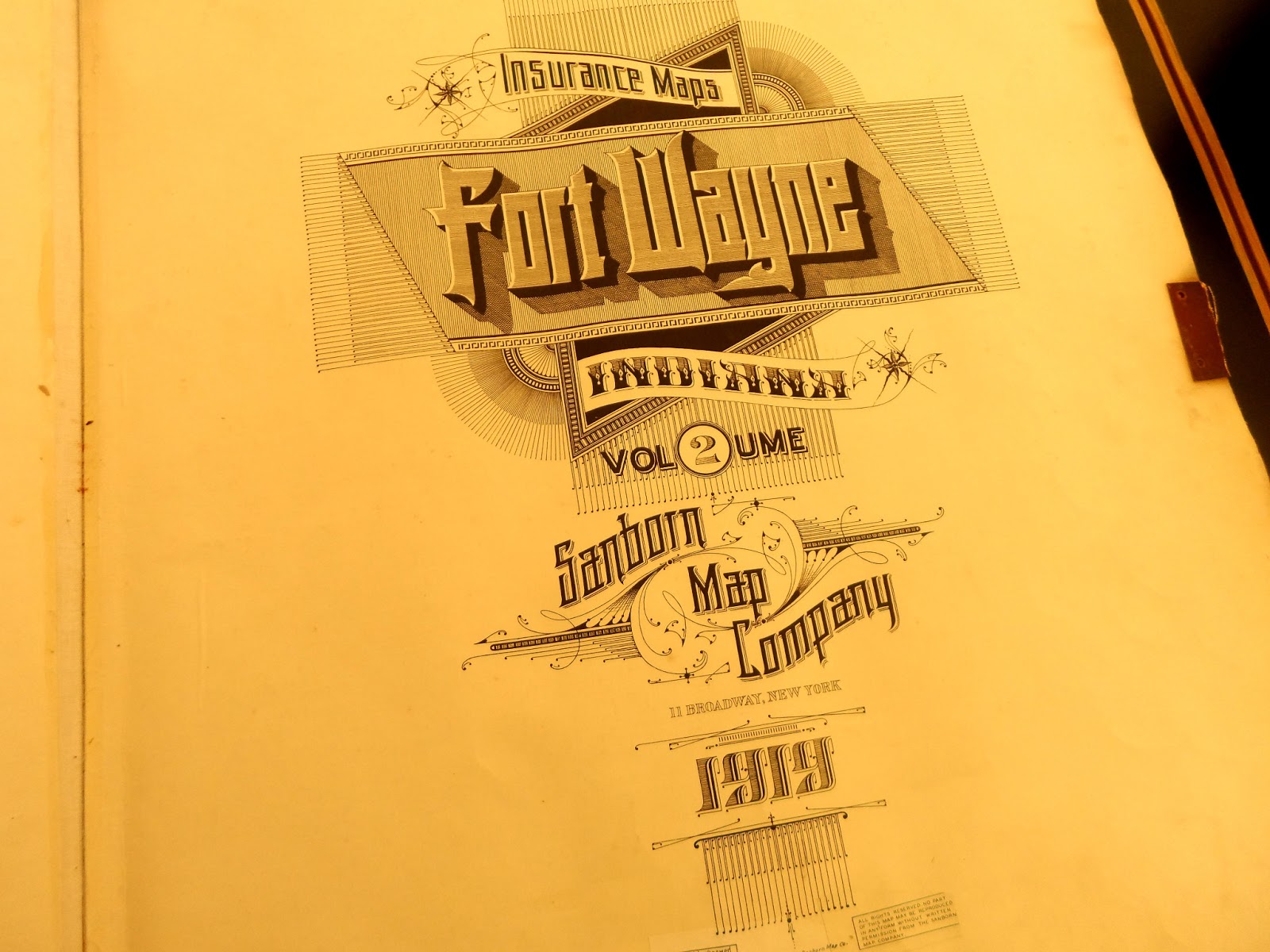
Sanborn Title 1919

In the prior century, insurers in the sprawling city of London recognized the value of mapping to help determine their potential liability. Although this was common to the large insurers of Great Britain (who were the main providers of insurance in the early years of the U.S.) the practice of mapping in the United States was sporadic.  In 1852, Aetna Insurance commissioned William Perris to generate the first comprehensive fire insurance map of New York City. A few years later, a Perris assistant, Ernest Hexamer generated a similar map of the city of Philadelphia. It was clear from these early efforts that this new detailed form of surveying and mapping had a real value in the burgeoning industrial cities of America. 
 However, initial growth was tempered by the outbreak of the Civil War. 
Sanborn Book


Sanborn Map of Downtown


Following the war, a new name entered the business, Daniel Sanborn. Sanborn created some Tennessee maps under contract before realizing the potential lucrative nature of the business. In 1867, he founded the Sanborn Map and Publishing Company. His maps introduced a distinct use of colors and key symbols to make the data easier to quickly process and understand.
Sanborn Key


Thanks to the growth in industry, population, and western expansion, The Sandborn Map and Publishing Company rode the wave of the Industrial Revolution to great success. By 1915, through merger and acquisition, the Sanborn Company, as it was then-named, held a near-monopoly on the business. Through those years, the Sanborn Company accumulated detailed maps on virtually every city in America with a population exceeding 2,000. This collection of maps, once of incredible importance to insurance underwriters, has become an invaluable source of information for a variety of other purposes, including local history. Fortunately, these once highly-guarded documents are readily available to you and me.

The Genealogy Department of the Allen County Public Library houses two multi-volume sets of original, oversized, leather-bound 1918-1919 editions (977.202 F77SAN Oversize). The publications hold 21” x 25” pages of heavy stock with detailed maps at a scale of 50’ to an inch. At the front you’ll find a detailed key specifying property and structural details. You’ll also find an overview indicating the page number for specific sections that are generally 4-6 square blocks in size. In the rear of the publication you’ll find a glossary to locate maps by street names and numbered addresses.
 
These volumes are working copies that were updated through the early 1950s. Through the years the Sanborn Company would provide new pages or “paste-overs”. These “paste-overs” were corrections printed on semi-transparent paper which were then pasted atop the original map. In some cases corrections were pasted atop earlier corrections resulting in a visual history of change with a somewhat three-dimensional feel. Nowhere is this more present than the pages for the several blocks surrounding the Allen County Courthouse. Since the maps were updated through the mid-1950s they provide a clear view of downtown Fort Wayne at the peak of its role as the business and retail center of the community. 


Wolf and Dessauer

You’ll find the Wolf & Dessauer Department Store later destroyed by fire, its competitor The Grand Leader, and several multi-story hotels that were thriving downtown. In most cases you can read through the paste-overs to see the businesses or structures that preceded the last entry.
 
Outside the downtown area you’ll find a detailed record of the industries in the city in those years. Following the railroad tracks east from downtown reveals the extensive Pennsylvania Railroad yards and major manufactures like General Electric and Tokheim. In the case of these major industries the building info not only details construction materials but also indicates where departments are located within the structure.   

You’ll find long lost buildings, like the many structures of the former Indiana Home for the Feeble-Minded that stood on what is now Northside Park on East State. Keep in mind the accuracy of the 50’ to 1” scale which allows you to determine the actual locations of anything found on the pages of these beautifully rendered maps.
 
I am a lover of maps and books. To me there is no substitute for handling the real thing. In this case, there is a palpable sense of history turning each page of the massive Sanborn volumes. At the same time, I’m a creature of the internet so I was pleasantly surprised to find the Sanborn maps online.

The Sanborn Map Company and its holdings have changed hands since its heyday in the 1930s. The assets, primarily the maps, are currently owned by Environmental Data Resources (EDR), which integrates original Sandborn data with current GIS data to determine potential environmental risks with current-day property. However, their exclusive rights pertain only to maps and data post-1924. The thousands of pages of color-coded maps produced from 1883 through 1923 are in the public domain. As such, these maps are available with no use limitations. You can download, view, and print as you wish thanks to the Indiana Spatial Data Portal (ISDP), a combined effort of federal, state, and local organizations and agencies hosted online by Indiana University. In conjunction with Historical Information Gatherers, Inc., all the original Sandborn maps for Indiana communities were scanned into an ISDP database and are available at the ISDP website

On the menu at the home page select Dataset Information, then select Sanborn Historic Maps. On the Sanborn Historical Maps page select Single File Interface. Once there you can specify the location you desire. You’ll need a PDF viewer on your computer but no other special software is required. In the PDF format you can expand at ease making the small print readily accessible to aging eyes like mine.

For Fort Wayne you’ll find full surveys from 1890, 1902, and 1918-19. Unlike the large paper maps you will not find the semi-transparent paste-overs. This is helpful when searching for the earliest land use on record which can be obscured by multiple paste-overs. You’ll also find surveys for several other communities in Indiana that you can search from the comfort of your own computer chair.

The Sandborn Maps are but one of many resources available to you on your journey through local history. But, be prepared to walk away with more mysteries to solve than questions answered. If you find your way to the Genealogy Department of the ACPL to peruse the oversized pages of the three volumes of maps please  enjoy your trip, consult with the nice people at the Help Desk, and be very, very sure you put your phone on vibrate. Believe me, you’ll be glad you did!


Some helpful resources:

Fire Insurance Maps, Oswald, GC973 0s9fi.  ACPL,
A brief history of Fire insurance maps.

Description and Utilization of the Sanborn Map,  Sanborn Co.,
GC929 SA539,  ACPL,  A guide to map use published by the Sanborn Company.

Monday, March 11, 2013

Finding Benjamin – Connecting Past and Present at the Genealogy Center


Today's blog comes from Carmen Hamilton, a history major at IPFW. 

 by Carmen Hamilton

History at its finest is a good story, the kind you stay up all night reading. A story is only as good as its ability to reach the listener on a personal level, and to fall in love with history is to make a connection that transcends time and geography.  I’ll explain how I found that connection, right here in Fort Wayne, and why I feel so many young people haven’t been able to do the same.

Benjamin F. Wallace is my answer when anyone asks where my interest in history came from. He was born in Vermont in 1834, and died there in 1853, just eighteen years old.  I was born in Indiana, in 1991. Our lives are separated by nearly 140 years and 800 miles, give or take, but they overlapped in a unique way during my sixth-grade year.  I remember stumbling upon his tombstone in the woods near my house in rural Noble Country, clearing away creeping vines to read the words, tracing the letters with my fingers to decipher them:

BENJAMIN F.
son of
Seth and Desire
WALLACE
Died Jan. 3, 1853
Aged 18 yrs. 2 mon.

For me and my friends, the finding provided ample fodder for our active imaginations. We formulated dozens of scenarios surrounding Benjamin and what might have caused him to die so young. He could have been ill, or he could have been killed in a duel – slain by a rival while fighting for his sweetheart’s hand. There were whispers of murder, but this version was a little too scary to imagine further. We felt sorry for the stone, alone in the woods with no visitors. One day, we left flowers. A week later, they were gone…replaced by a folded sheet paper, which turned out be a photocopied newspaper article, headlined: 

Monolith Haunts I&M Basement

The article revealed that the tombstone had been discovered in the basement of the since closed I&M building, located on the Main Street of Kendallville (about 30 minutes north of Fort Wayne).  According to the article, the tombstone was not made of mineral located in the area, nor had anyone of that name died in Kendallville. Instead, the stone had been transported all the way from Vermont, presumably by horse-drawn-cart. How and why these events took place were lost to history, or at least not mentioned in the newspaper.  Weeks after the building’s closure, the stone had appeared mysteriously in my neighbor’s yard, who guessed it had been left as a prank. He, too, felt sorry for Benjamin, and decided to place the stone in a peaceful spot in the woods. 

For me, this development stirred up more questions than answers. I felt like Nancy Drew with a mystery to solve, unsure of where to look for clues. A few weeks later, I came across a brochure for The Genealogy Center in the Allen Country Public Library. The center boasts one of the largest genealogical research collections in the nation, and offers access to the records of Ancestry.com.

On my first of many visits, I found out that numerous people named Benjamin Wallace had lived in Vermont, but only one had been born to Seth and Desire, and had died in 1853 at age eighteen. This was my Benjamin – no longer a name carved on a cold slab of stone, but a real person. I learned that he was one of seven brothers, all of whom had died before the age of twenty-five. He was descended on his mother’s side from English immigrants who arrived to Connecticut in the 1640’s.

Unfortunately, this little information was all I could unearth, and much of Benjamin’s story – such as how and why his headstone came to be in Indiana – remains a mystery. However, the investigation itself had opened my eyes to world of genealogy. If I could research the life of someone I’d never met, why not research my own relatives? With the help of older family members and the staff of the Genealogy Center, I began to piece together my own family history.

Centuries ago, my ancestors were scattered across Europe, North America, and even Africa. They were among the first immigrants to settle in colonial America, and also among the natives, waiting on the shore of that new world. In the American Revolution, one fought for independence of a new nation, while another defended ties to his home country – both died for their cause, never knowing which side would win, or that they would one day share a descendent. In the Civil War, my ancestors wore both blue and grey: one was a plantation owner, another, his slave, and yet another, an abolitionist who assisted the efforts of the Underground Railroad. 

As I learned their stories, my ancestors, like Benjamin, became more that names on paper. Some of their stories made me happy, while others brought tears to my eyes; some made me proud, and others made me wonder.  I felt I had met not only my ancestors, but myself in a new and deeper way. I am more than a small-town, Indiana girl: I am a dreamer and a sailor, an explorer and a native, a redcoat and a patriot, a slave and a captor, a Yankee and a rebel, with the blood of three continents and many nationalities running through my veins.  It wasn’t until I learned where I came from that I truly appreciated who I was, or knew where I wanted to go.

For me, the vital connection between past and present had been made at the Genealogy Center, sparking a lifelong passion for history. Unfortunately, numerous young people have been unable to make this connection, and therefore feel less than enthusiastic about the subject. For most, the aversion can be traced to high school, where students were expected to memorize key dates, names, and facts, but never learned how the events of the past relate to their lives and the world they live in.

While passion for his subject is desirable in an educator, many teachers are so in love with history that they forget they’re addressing people who are not. The best way to hold an audience’s interest in history is to present it in the form of a story. When properly framed, there is potential for action, horror, mystery, and drama. Historical figures are recognized as individuals with genuine emotions, strengths, and weaknesses. Their lives and their challenges were real, and the impact of their decisions ripples into the world today. Students will begin to care when they can trace causes and effects over several generations. And once they care, the memorization of important dates, names, and events will no longer seem a burden.

I would also encourage educators to introduce their classes to the Fort Wayne History Center and the ACPL Genealogy Center. Both are treasure troves of local and family history that can make the subject instantly more relateable to students. This was the case, at least for me. My ancestors may not have been kings, or inventors, or military heroes, but as I study the times in which they lived, I hear their names echoed in a professor’s lecture, their stories whispered in a textbook’s pages, their strangely familiar voices, calling from the past.