Thursday, April 28, 2011

Julia Emanuel, The Lady in Lavender

The year is 1889. Imagine a tall, slender young woman at work in the back room of the Meyer Brothers Drug Store at the corner of Calhoun and Columbia Streets. She is Julia Emanuel, a recent graduate of the College of Pharmacy of the University of Michigan, the only woman in her class of forty one students. Like her male colleagues, she takes great pride in mixing powders and syrups to meet the needs of the pharmacy's regular stream of doctors and customers. Unlike her co-workers, however, Julia spends her entire work days in the back room. Even though a pharmacist, she is made to feel odd! She is not allowed to wait on the customers because that is not what women do. She feels like a skeleton living in the firm's closet!

Women in this period rarely graduated from college or even thought of pursuing a career outside the home. Instead of feeling discouraged by this rigid discrimination, Julia Emanuel, the pharmacist, became a legend in Fort Wayne. Sometimes referred to as "the lady in lavender" because she loved purple, she was an ambitious, talented, one of a kind entrepreneur and bon vivant!

For ten years Julia worked in the back room of Meyer's Pharmacy; then she broke free and started her own business. Over the years, she operated from locations on West Berry Street and on West Wayne Street. Her first shop was 25 feet square with neither a furnace nor a stock room. For her first twenty years in business, her shop was known as the Arcade Pharmacy. She was afraid people wouldn't come to a shop with a woman's name on it. Finally, she changed the sign to read Miss Emanuel's Chemist Shop. She was now a downtown landmark. Her hours were from 8:00 a.m. to 10:00 p.m.

Julia instilled confidence in her customers with her great accuracy in filling prescriptions. At heart she was a chemist. She became known for her headache powders, special creams and beauty products.

Julia projected a female perspective. She wanted her customers to take from her store "a sense of warmth, friendliness, and confidence." When she was able to hire employees, she insisted on hiring only women. She also wanted her employees to be college graduates.

What gave Julia the special drive that she needed to be so successful and unique for her time? People often said that she was born to be a pharmacist. She came from a family of doctors. Her father, grandfather, and three uncles were doctors. She grew up surrounded by talk of medical cures. Her mother was also a powerful role model. Julia's father had died when she was a young child; starting with his collection of medicines, her mother opened pharmacies in Antwerp and Paulding, Ohio, to support her three small children. Julia knew first hand the importance of being an independent woman. No surprise that she was active in the suffrage movement!

After fifty two years as a pharmacist in Fort Wayne, Julia retired in 1943 at the age of 73. Two years later, however, she returned to work at Jefferson Pharmacy because of the manpower shortage during World War II. After the war, she became known as an avid golfer, community volunteer, world traveler and bon vivant. She loved being surrounded by friends; she especially loved attending University of Michigan football games.

Julia also loved to express her opinion. "Age! That's simply a matter of the mind. It never occurs to me to consider age as a barrier. When I want to do something I do it," she told a reporter when she was 75. She was still getting good golf shots and walking the course. "And don't forget good posture. Standing erect is not only more comfortable, but it keeps us healthier in our bodily functions."

And so Jullia Emanuel kept playing golf, kept globe trotting, kept wearing lavender, and kept having a good time until her death in 1962 at the age of 91.

Tuesday, April 19, 2011

A Magnificent Religious Artifact

Fort Wayne is often called "The City of Churches," and for good reason.


A search of the skyline reveals many steeples and domes that reflect the religious faith of local residents. Religious worship has taken many different forms. Some congregations worship in ornate settings in edifices that are more than a century old; others worship in newer or more simplified settings. Occasionally, a congregation will redecorate the interior of a church and discard items of historical significance. Some of these artifacts have found their way into the collection of the History Center.

One item of significance on display in one of the main floor galleries is a painting from the former reredos of Trinity Episcopal Church, located at 611 West Berry Street. A reredos is a structure, usually of wood or marble, that is placed behind the altar of a church. They are found commonly in the Catholic, Lutheran, and Episcopal churches, and also in other denominations. Sometimes they contain paintings or carvings of religious significance, and many versions in Europe are of medieval origin.

Trinity Episcopal Church was founded in 1844, and its present edifice was completed in 1866 - a Gothic revival building designed by architect Charles Crosby Miller of Toledo. The interior has undergone a number of redecorations in its history, including one in 1893, another in 1925, and several others in more recent times. In 1925, Trinity's rector, Rev. Louis Rocca. commissioned the New York architectural firm of Bertram Grosvenor Goodhue and Associates to redecorate the nave in a colorful style that resembled a fifteenth century European church. (The firm had recently completed the design of Trinity English Lutheran Church nearby). The old Victorian stenciling on the walls were replaced with deep shades of red, blue, and gold, and much of the old varnished woodwork was repainted.

The centerpiece of the redecoration was a new painting for the reredos, replacing an earlier painting of Jesus as the Good Shepherd. Bertram Grosvenor Goodhue commissioned a pair of New York City artists, Telford and Ethel (Parsons) Paullin, to design a new painting. The Paullins had worked with the firm before and were well known. Telford Paullin (1885-1933), a native of Le Mars, Iowa, had studied art in Chicago before coming to New York City. He and his wife Ethel became captivated by Byzantine art as it appeared in Eastern Orthodox churches, and they adapted it to their own style, which they exhibited in many churches, especially in the East. Several years earlier the couple had painted a series of medallions in Byzantine style for the Chapel of St. Bartholomew's Church in New York City, as well as other works of art for the Church of St. Vincent Ferrer. Ethel was known both for her painting and her design of original tapestries. Both had experience painting murals and frescoes. Telford painted a colorful series of paintings comrpising the Stations of the Cross.

The painting created by the couple for Trinity Episcopal church depicts Christ in the sacred role of priest. He holds the Bible in his left hand, and his right hand is giving a traditional blessing. He is surrounded by a group of angels and saints, including St. Mary the Virgin on the far left. The Paullins prepared several studies and watercolors of the painting before completing the final version, and copies of these studies are housed in the Trinity Church Archives.

When the painting arrived, Father Rocca wrote Mrs. Paullin a letter of thanks, praising the work as "a source of constant joy." He added: "The wealth of sympolism you have imbedded in this painting, and the happy choice of color combinations - in fact, your exquisite and masterful treatment of the whole subject - make the painting one which is thoroughly unique, and most precious indeed. It blends in admirably with the general tone of our Fifteenth Century Gothic decorations, and is, as it should be, compelling to the eye the moment one enters the Church."

Some parishioners disagreed about the scale and cost of the decorations. Many agreed that the painting was better appreciated up close, where its minute symbolism could be carefully studied, than from a distance. When the church underwent another redecoration in 1962, the old reredos was removed and a new one installed. The painting found its way into the History Center collection, where it remains on display.

Religious artifacts teach us much about the diversity of Fort Wayne's spiritual heritage. When viewing them, one sees both the commonality and divergence of that experience. It is fortunate, indeed, that items once cast away by a congregation can find a new home in the Museum.

Monday, April 11, 2011

Irene Byron, A Crusader Against Tuberculosis


One hundred years ago this spring Fort Wayne began its first all-out effort to defeat the most dreaded contagious disease of the day, tuberculosis.

Known as the "white plague," tuberculosis was often a fatal side effect of the town's booming industrial prosperity. New jobs and rapid population growth resulted in crowded housing that often lacked basic sanitation. Workplaces were often no better. Such conditions combined with long working days and poor diets, not surprisingly, became life threatening.

In 1909 city board of health officials were alarmed by 122 fatalities from tuberculosis. At the end of March and in early April of 1911, the League sponsored a health week at the downtown library described as "the greatest of its kind ever held in Indiana." Speakers included a leading bacteriologist from the University of Wisconsin, the health commissioner of Chicago, and Fort Wayne native Dr. Alice Hamilton.

Local audiences no doubt took great pride in Dr. Hamilton. A graduate of the University of Michigan School of Medicine and a former student of the Fort Wayne College of Medicine, she was already recognized for her public health work at Chicago's Hull House and her investigations of hazardous workplaces.

All week hundreds of people listened to lectures and viewed exhibits, taking away a better understanding of different strains of tuberculosis. Scientific research showed that the strain most responsible for killing infants and children could be controlled by strict inspection of milk. There were no known cures for the most contagious form of the disease, the strain that infected the lungs and often proved fatal. What experts did know, however, was that communities faced a life or death public health battle.

In 1913 Irene Byron, a young graduate of the Hope Hospital Training Program for Nurses, began work as the visiting nurse for the Anti Tuberculosis League. In this role, she had responsibility for educating patients in the importance of sanitation. If the disease were caught in the early stages, a good diet, fresh air, and rest could help patients recover.

Miss Byron and other leaders of the Anti Tuberculosis League quickly learned, however, that Fort Wayne was experiencing a tuberculosis epidemic. By September of 1913 more than 600 local residents were suffering from the disease. Two hundred were so sick that nothing short of a miracle could save them. Most of the remaining 400 victims might survive if they could be propery cared for. While tuberculosis sanitariums were becoming established elsewhere, Fort Wayne at this time lacked such facilities.

As a first step, the Anti Tuberculosis League opened a free clinic and dispensary. Irene Byron, now as the league's excecutive secretary, took responsibility for supervising programs of home care. In the summer of 1914 Irene Byron began campaigning for an outdoor hospital that would enforce strict rules of rest, diet, and fresh air. Thanks largely to her efforts, the following spring the Anti Tuberculosis League opened Fort Recovery, a group of wooden huts that housed twenty patients, even very young children.

Miss Byron continued to care for hundreds of other patients in their homes. At the same time she crusaded for a fresh air school to help underweight chidren become more robust. Irene Byron clearly risked her life through her regular visits with TB patients. By the winter of 1915, such exposre had taken its toll, for she was forced to take an extended leave of absence to visit family in California. She apparently regained her health, for when the call went out in the fall of 1917 for nurses to serve in World War I, she was one of the first from Fort Wayne to sign up.

Knowingly, she again risked her life to care for soldiers stationed at Camp McArthur in Waco, Texas, stricken with influenza. Despite the hardships she faced, she hoped to be sent to war areas in France.

Within less than six months in Texas, however, Miss Byron died, becoming Allen County's first woman martyr of the war. She was only 36 years old. Irene Byron's efforts to fight tuberculosis in Fort Wayne nevertheless continued. In the summer of 1919 a new modern sanitarium was dedicated in her honor to care for soldiers returning from service.

Until medical cures were developed in the 1950s, the Irene Byron Sanitarium continued to be a leader in Indiana's efforts to defeat the "white plague." Some one hundred years after the beginning of Irene Byron's public crusade against tuberculosis, it's appropriate to remember the origin of the current Byron Health Center on 12101 Lima Road and its namesake. The young nurse who so courageouosly led the public health battle against tuberculosis has long inspired others by her example.


[Writer's note - Hope Hospital was the forerunner of Parkview Memorial Hospital. Newspaper sources for this article include Journal Gazette April 1, 1911; March 29, 1918; and Daily News January 15, 1916. The photo of a main sanitorium building, now razed, is courtesy of the Allen County Public Library Community Album. The previous owner captioned the photo "Weary days & weary nites."]

Friday, April 1, 2011

Wager Your Wit

A new season of Wager Your Wit begins on April 4. We'll be posting photos of the items on our Facebook page. For more information, you can also call the History Center at 260.426.2882.

Monday, March 28, 2011

On Grandma, Green Tomatoes, and Hard Times

Tired of all the bad news on the economy, I recently re-read the “Little House” series of books. I hadn’t picked them up since elementary school, and it was a delight rediscovering the compelling, well-crafted stories of Laura Ingalls Wilder’s life.

Some of the stories sent a chill down my spine, because I understood their implications in a way that I couldn’t as a child.

For example, how the family listened to the war drums of the Indians along the Verdigris River. The family was squatting illegally in Indian-controlled territory, and the Indians were not all terribly pleased by the appearance of white settlers. (The story becomes a heartbreaking one when you look at it from the perspective of the mother of the black-eyed papoose that stole Laura’s heart, as the Indians headed West in a great line of ponies and people).

Likewise the story of The Long Winter, when the family nearly starved to death. Most of us have never been truly hungry a day in our lives, so how can we conceive of the fear of starvation and sickness that ripples in an unspoken undercurrent through the story, as the snow-bound town waits for trains that never come? The family had reached the point where they were listless with hunger; Pa’s hands were so cut and swollen from braiding hay for the fire he couldn’t play the fiddle; and the most chilling detail of all can be imagined in how he must have looked:
"They all began to talk again, but Mr. Ingalls rose up tall and thin from the box by the stove. His face had shrunken to hollows and jutting cheekbones above his brown beard, and his blue eyes glittered bright. "
One detail that struck me was how at the beginning of the book, the family’s garden struggled on the freshly-broken sod. When frost strikes, Ma gathered all the leftover green tomatoes and pickled them. She only got two quarts. It doesn’t say how long the pickles lasted, but how delicious they must have been, and how quickly they must have disappeared. The rest of their harvest comprised five bushels of potatoes, a gallon of sweet relish, a bushel of beans, “lots of turnips,” some corn, and just six yellow-gold pumpkins. It wasn't much.

This is one of those moments where a book sheds a new light on your own life. This past fall I had a bounty of green tomatoes on the vine as frost threatened; they weren’t far enough along to ripen inside, so I picked them and—since I was in the midst of a canning kick (again, don’t ask; it’s genetic)—canned 12 pints with dill and vinegar brine following the direction in the canning bible known as the Ball Blue Book (which is no longer blue, by the way).

I am not sure exactly how I expected them to taste, but upon opening the first jar four weeks later, found that they tasted exactly as a home-grown, home canned pickled green tomato should taste…which I am sorry to say, was not entirely to my liking. In fact my thought was, “Yuck! This tastes like some weird thing Grandma served me when I was little!” So other than an additional jar opened for my book group, for demonstration purposes and which they claimed to like, the green tomatoes have sat all winter on the cellar shelf.

Here is where the local history part comes in. After reading the Little House books, a light bulb went on in my head, and I scrounged through the motley collection of church cookbooks that came to me from my Grandmother Balliet. I had previously amused myself reading the ones from the 1960s and their bedazzling array of dubious “salads” involving jello. But in 1948, the Lutheran ladies of LaOtto, Indiana were all atwitter over pickles. In addition to the 14 official pickle/relish recipes, my great-grandmother and grandmother had handwritten several additional pickle recipes, including one for pickled crab apples.

Obviously, farm women who were scarred by the privations of the Great Depression canned everything they could get their hands on. They carefully saved their seeds from year to year, grew copious gardens, and had root cellars full of the bounty. Sure, they could always go to the grocery store if they ran out before spring…but that would entail hitching up a team of horses and driving miles into town down the Lima Plank Road (which was composed of actual planks) in the dead of winter. Better to work hard, save your money, and ensure that your babies and husband will stay fat and sassy all winter long from your labor of love, even in the depths of Depression.

So on a whim I canned pickled green tomatoes last fall—along with a half-bushel of peaches, 6 quarts of applesauce, 12 pints of an insanely good heirloom tomato, roasted garlic and basil marinara, and I forget how many pints of dilly beans. I was really proud of the accomplishment, because it was really hard work, because I grew most of the tomatoes and greenbeans, and because my toddler son wolfs down his mama’s peaches, applesauce and pasta sauce in messy euphoric handfuls and clamors for more.

But after thinking about it from the perspective of my great-grandmother and her family, or the Ingalls family, or people who are going hungry in our own town today. it is somewhat shaming to have the luxury of being a picky eater. Or to regard my sliver of vegetable garden as entertainment, not really caring if we ate the food, or it happened to rot on the vine or kitchen counter. Or to pat myself on the back for a cute little supply of food that wouldn’t last a farm family a week in the winter. Or to drive a car powered on gasoline mixed with ethanol—a practice that burns a third of the U.S. corn crop in one of the most incredibly inefficient modes possible, while China’s cereal crop dries under sun and the price of food sparks riots worldwide.

It’s a lot to think about, and takes me right back to the grim economic headlines from which I was originally seeking refuge. But it certainly puts “hard times” into perspective. While there has been a spike in people who garden, can, knit or raise chickens, it’s generally not because they are financially pressed, because each of those activities is more expensive in both money and time than just picking the same item up from Walmart. It’s because they are yearning for self sufficiency and connection to the past.

And that is the power of history—to know that you likely have the same knife nicks and dings on your hands as Ma Ingalls; that your great-grandmother probably burned her fingers too when she hauled hot cans out of the boiling water bath; and that you are using the same Indiana-based Ball canning jars as your family for generations—like any good Hoosier. And it gives extra relish to a taste you might not immediately like, to think of how delicious the flavor of pickled green tomatoes would be to a family that faced down the never-ending winter of 1890, or scrimped and saved during the Great Depression.

So maybe I’ll crack another jar open tonight…and dare I try Eliza Jane’s recipe for pickled watermelon rind from Farmer Boy…?

Tuesday, March 22, 2011

What's behind a display?

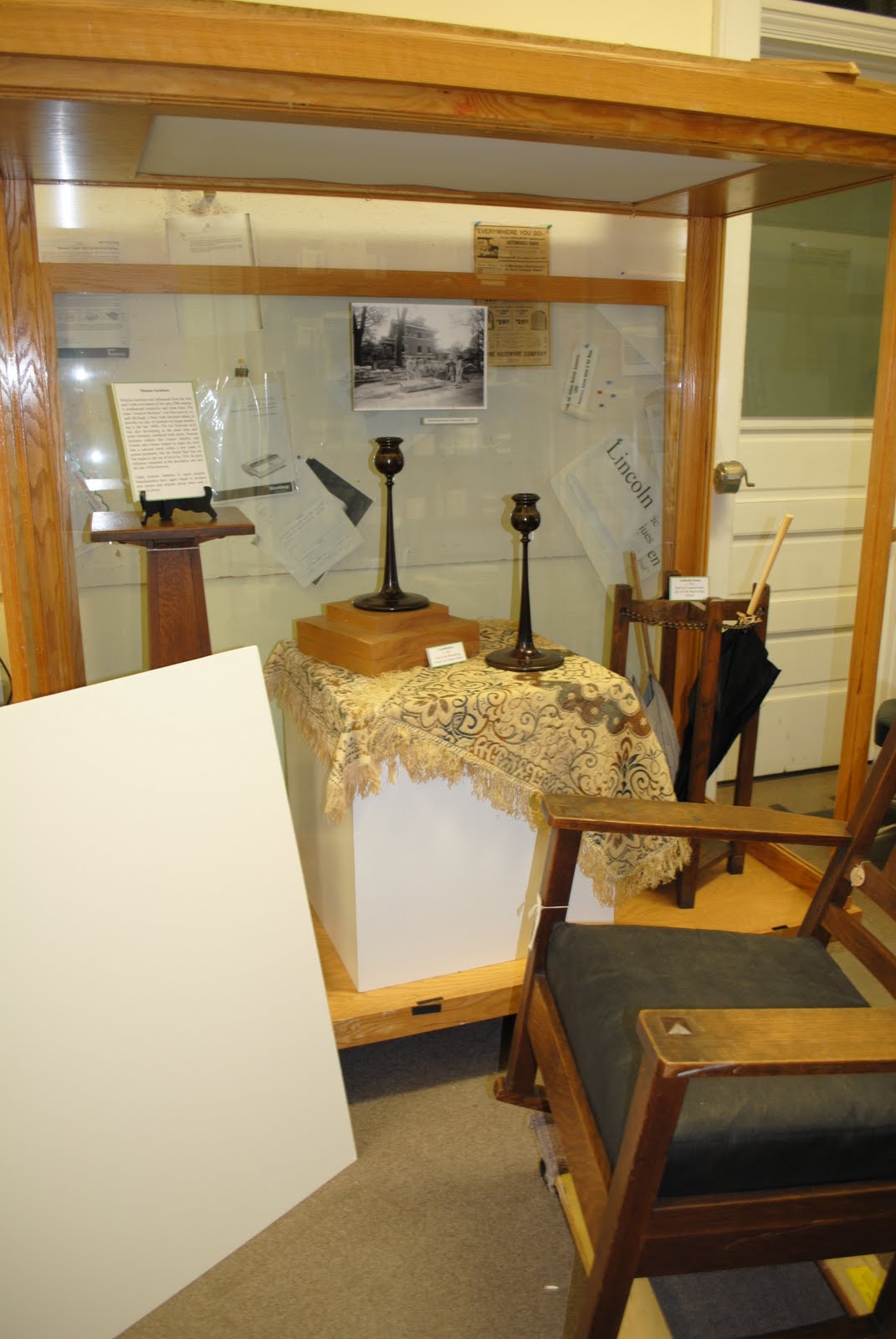
We thought you might enjoy seeing how our exhibitor, Randy Elliott, puts together a display. The photos here were taken as Randy worked on the display of Arts and Crafts items which will be on view this month at the History Center.


An Arts and Crafts Crib

There are two ways items are shown to the public at the History Center: exhibits, which are components or distinct spaces of the galleries depicting specific eras in Allen County/Fort Wayne history, and displays, which are temporary groupings around a topic such as fashion or architecture.

A great deal more work goes into setting up a display than you might imagine. First comes research. Randy utilizes various resources on the web to find items that are representative of the time that is being depicted in the display. Since dates seldom match, he looks for a consensus among a number of web sites for his use in determining what kinds of artifacts to look for within our collection.


Researching the Arts & Crafts Display


Then Randy must locate items in the History Center’s collection, make sure all of the cases being used are clean, clean the items for display, find appropriate props to go with those items, determine the layout of each case, and then….actually get to the work of setting up the cases and moving them into place.


Moving and assembling a display case

Signage is also a necessary component and most displays will have main, secondary and title signage as well as artwork gleaned from printed materials if an actual artifact is not available.


As you can see from these photos, our display cases are portable…to the extent that it takes at least two guys to move them…and sometimes four to put them together.


The display cases are moved from staging to the Shields Room and other cases set up for additional displays.


Most of the work is accomplished “behind the scenes” because the museum is open to school groups and others while the displays are being set up and wheeled into place. We love our building but one of the challenges of utilizing a structure built for another purpose is that you use what space you have instead of a space designed for a specific purpose. Thus our “staging area” is really just a former office and we have our artifacts in various parts of the building, necessitating going from floor to floor gathering items for displays. Museums that are new construction often will have staging areas built into the design which provide for better efficiency. But our historic building—which is an exhibit in and of itself-- has far more atmosphere than a newer model.


At work in an office downstairs where signage tools are stored and some displays set up.


Wednesday, March 9, 2011

Addie (Bleekman) Guldlin, a Notable Reformer


On the south side of the St. Mary's river off Sherman Street, near the site of an eighteenth century French fort, is Guldlin Park, which will celebrate its centennial this spring. It was named for Addie (Bleekman) Guldlin (1863-1935), a champion of women's rights who is almost forgotten in the annals of Fort Wayne. Mrs. Guldlin had spearheaded the creation of the park, the city's first playground, dedicated for use by children. So who was Addie Guldin and why is her legacy so important and at the same time so neglected?


Mrs. Guldlin was born on 25 November 1863 in Stratford, Fulton county, N.Y., the second child and only daughter of Jerome Bleekman, an entrepreneur and lumber mill owner, and his wife Henrietta (Sixby). As a child she moved with her family to Rarden, Ohio. She graduated from Buchtel College in Akron, Ohio, in 1888, and the following year on 28 August 1889, she married Olaf N. Guldlin, a Norwegian immigrant and speculator in natural gas wells. The couple moved to Allen County in the 1890s with her parents. Olaf invested inthe Western Gas Construction Company at a time when there was a booming interest in natural gas wells in Indiana. He invested wisely and made a fortune, purchasing a large home at 2306 Fairfield Avenue and a cottage at Clear Lake. The Guldlins traveled in the upper social circles of the city, and they were childless.


Mrs. Guldlin had an assertive personality, was deeply interested in a variety of reform movements, and was not content to simply be an ornament for her husband. She became deeply interested in the women's suffrage movement in Indiana, which had made little progress in Indiana because of organized liquor interests whose advocates believed that giving women the vote would usher in Prohibition and harm the saloon industry. Frustrated by this lobby, many women became strong proponents of social clubs that promoted activist agendas outside of suffrage.


Among the clubs that attracted Mrs. Guldlin's interest was the General Federation of Women's Clubs. She became a strong advocate of its Domestic Science Department, believing that women should receive formal training to be homemakers and that keeping house was an art form. She went on the lecture circuit in the early 1900s, not only addressing the need for domestic science, but promoting the cause of women's clubs in general, arguing that women could play an activist role in many spheres in their own communities.


When giving a lecture for the Federation in Indianapolis in 1911, the Indianapolis News called her "one of the most prominent women in America" and added, "She is an enthusiast who speaks with much faith as to create a new appreciation for the subject to those who listen to her."


On another occasion a local Fort wayne newspaper described another lecture appearance: "Mrs. Guldlin never looked more charming in her life than on this evening, as she stood on the platform becomingly gowned in a creation of soft blue, her eyes lighted with animation and her whole being filled with enthusiasm in her subject." Despite the reporting style that seems sexist in a modern context, her remarks were hard hitting. She described having visited San Francisco in the wake of the 1906 earthquake and the utter corruption of its local officials. Many of the officials were headed justly to prison. The local women made a difference, she argued, in making San Francisco a new city with higher ideals. Women, she added, should receive liberal educations. "You can't estimate what you will receive by the cost."


Here in Fort Wayne, Mrs. Guldlin became deeply involved with the City Beautiful Movement and was a strong supporter of the new Park Commission. She began advocating for playgrounds for inner city children who, she argued, had no safe place to play. As a result the park commissioners dedicated Guldlin Park in her honor on May 20, 1911, complete with new playground equipment. Unfortunately, much of her work was destroyed two years later during the 1913 flood.


She continued to advocate for other civic improvements with the support of the Women's Club League. In 1912, she attended a city council meeting as the sole female member of the Civic Improvement Association. In advocating for a bond issue for the Park and Boulevard Plan devised by George Kessler and supported by the Park Commissioners, she told the councilmen: "You see, the women can vote as well as the men at the ward meetings which are being held with the city council." Unfortunately, that particular bond measure was defeated.


Mrs. Guldlin crusaded for women's suffrage, and with Carolyn (Randall) Fairbank attended the first state convention of the Woman's Franchise League of Indiana, held in Indianapolis in 1912. In her article, "Winning the Vote in Fort Wayne, Indiana," published in the Indiana Magazine of History in 2006, historian Peggy Seigel has shown that suffrage efforts in Fort Wayne lagged behind other areas of the state, again because of the liquor lobby and its support by many of the city's German-Americans. Still, she rejoiced at the passage of the Nineteenth Amendment that gave women the vote. She played a prominent role in reorganizing the former Franchise League into the Fort Wayne League of Women Voters. In the 1920s she was the only woman to serve on the City Planning Commission. She was also instrumental in securing the Theodore Thieme mansion and remodeling it for the Fort Wayne Museum of Art.


Addie (Bleekman) Guldlin was a pioneer of women's rights in Fort Wayne and an important activist at the turn of the century, and Guldlin Park remains a fitting tribute for her efforts.