Tuesday, November 24, 2015

Allen County’s Amazing Library

(Fort Wayne Monthly “Along the Heritage Trail with Tom Castaldi” – March 2011, No. 76.) 


The concept of a public library had its beginnings in 1850 when Allen County provided for one in its budget and the newspapers listed the new books available.  A reading room was established on Wayne Street in 1887 with private funds by Emerine Hamilton.  She was Emerine Jane Holman a southern Indiana woman whose father, Jesse Lynch Holman, was a judge on the Indiana Supreme Court, a United States District judge and one of the founders of Indiana University and Franklin College.  One of the distinguishing features of Emerine and husband Allen Hamilton’s mansion was the thousands of volumes of rare and contemporary books that filled the shelves of several libraries in the big house.  She became the founder of the first public library in Fort Wayne, the predecessor to the Allen County Public Library.


Although state law had authorized a tax levy for a public library since 1881, the Fort Wayne City Council refused to respond until 1893 when the Woman’s Club League of Fort Wayne persuaded City Council to change its mind.  Fort Wayne’s first public library opened in January 1895, in a room in the new City Hall on East Berry Street.  Later that year, the library moved to its own quarters in the Sol D. Bayless residence at East Wayne and Clinton streets.  A new address for the public library was found in the Brackenridge home on the corner of Wayne and Webster streets in 1898.

In 1904, with a grant from the Andrew Carnegie Foundation, the first permanent public library was constructed at Webster and Wayne streets. During construction, the library was placed in the Elektron Building on Wayne Street.  The Carnegie building remained the library’s home until 1968, when it was demolished. The present building was constructed on the same site and the northwest wing was added in 1981.  On January 27th 2007, the doors were opened to a greatly expanded structure and Allen County improved its position as home to a world-class library.

The Allen County Public Library holds the second largest genealogical collection in the United States and was the first public library to obtain all the available Federal census records.  The origins of this extraordinary genealogical collection can be traced to the Great Depression when library director Rex Potterf and his young friend and disciple, Fred Reynolds, went on the road searching for inexpensive books to fill the library’s shelves.  Without much money to buy expensive new books, they found many local and family histories, directories and other records.
When Fred Reynolds became director of the library in 1960, he focused the collection specifically on genealogy, with a room set aside in the old Carnegie building.  Reynolds made arrangements with the Newberry Library in Chicago – then the largest genealogical collection in the country – to preserve Newberry’s prized and rapidly deteriorating books and records through a massive photo-copying effort at the Allen County Library.  Originals and a copy were sent back to the Newberry, but a copy also stayed in Allen County’s facility.  As many as 37,000 volumes of rare reference works were acquired by the library in this way, and these became the foundation of the great genealogical collection.  The practice continues with the library copying and binding donated family histories always returning a copy to the donor.  On a much larger scale major collections are preserved. When the Lincoln Corporation decided to close its Fort Wayne Lincoln Museum, the ACPL was chosen to digitize its massive book and document collection to be placed on the Web and a project that will take years to complete.

Today, our ever-improving library’s resources extend beyond genealogy providing excellent services for us all.  Stories like these help keep alive the assets of our community… making this a very interesting place in which to call home.

###


Allen County Historian Tom Castaldi© is author of the Wabash & Erie Canal Notebook series; hosts “On the Heritage Trail” which is broadcast Mondays on 89.1 fm WBOI; and “Historia Nostra” heard on Redeemer Radio 106.3 fm.  Enjoy his previously published columns on the History Center’s blog “Our Stories” at historycenterfw.blogspot.com.

Tuesday, November 17, 2015

Abraham Lincoln in Indiana


(Fort Wayne Monthly “Along the Heritage Trail with Tom Castaldi” - Feb 2011, No. 75)

                             
For many years the Lincoln Museum in Fort Wayne held a unique relationship between the people of northeastern Indiana and our 16th U.S. President. Not only did the museum hold the attention of area citizens, but it attracted scholars, historians, lecturers and Lincoln fans from far and wide to Fort Wayne. Today, the museum’s collection has been relocated with its artifacts to the Indiana State Museum in Indianapolis and its many documents to the Allen County Public Library.

It is appropriate that the contents of the Lincoln Museum – known to have held the largest privately owned Abraham Lincoln collection in the world – remain in Indiana. Here the images, records, documents, letters, books, and memories are gathered in the state of the Great Emancipator’s boyhood home.  Lincoln and his family came to southern Indiana in the same year that the state was established in 1816, and he remained here until 1830. He came when he was seven years old and by the time he left he had grown to be 6 feet 4 inches tall and weighed more than 200 pounds.

Lincoln, now well formed as a young man living in Illinois, visited Indiana on several occasions as he became more and more interested in the issues of the day. Former Lincoln Library Museum Director R. Gerald McMurtry gave an account of the highlights of Lincoln’s returned trips to his home state. In October 1844, Lincoln stopped off at Vincennes, Rockport, Evansville and Gentryville in support of Henry Clay, the Whig presidential candidate. Later in 1855, working on a legal case brought the future president by rail to Michigan City, Lafayette and Indianapolis traveling from Chicago to Cincinnati. With Mrs. Lincoln and one of his sons, Lincoln left Cincinnati on September 19, 1859, and arrived in Indianapolis in time to give a speech that evening during which Abe mentioned how his trip across the state revived his recollection of the earlier years of his life.

It was in 1860 that the now enshrined president was to make his mark as a serious presidential candidate and that director McMurtry noted was “the speech which made Lincoln president.” It was in February when Lincoln was on his way to New York to deliver his famous Cooper Union speech. A short news article appeared in Fort Wayne’s Dawson’s Fort Wayne Daily Times on February 23, 1860, “Hon. Abe Lincoln and wife came from the west this morning at 1 o’clock on the T. W. & W. R.R. (Toledo, Wabash & Western Rail Road) and changing cars at this city went east. ‘Ole Abe’ looked like as if his pattern had been a mighty ugly one.”  Mr. McMurtry was quick to point out Dawson’s reporting error. Mrs. Lincoln was not with Abe, but rather he was escorting Mrs. Stephen Smith and her son Dudley on the trip.  Mrs. Smith’s husband was a brother of Clark M. Smith who was married to Ann Todd, a sister of Mrs. Lincoln. Mrs. Smith was on her way to visit her girlhood home in Philadelphia and Lincoln agreed to assist her with her child and luggage.

At that time the T.W. & W. R.R. was located south of the Pittsburgh, Fort Wayne and Chicago (P.FW. & C. R.R.) tracks along Fairfield Avenue, according to rail historian Walter Sassmannshausen.  The T.W. & W.’s passenger station stood across the tracks from that of the P. FW. & C between Calhoun and Clinton streets. Even arriving one hour late on the T.W. & W., Lincoln had plenty of time to board the P. FW. & C at 1:12 a.m. and make his connection on his way to deliver his important Cooper Union address in New York on February 27th.  Upon his return on March 12th after leaving New York on the Erie Railroad, Lincoln changed rail cars at Toledo boarding the T.W. & W. line. That same day at 5:20 p.m. he passed through Fort Wayne without any notice.

Newly elected as president, Abe came through Indiana on his way to his inauguration in Washington, DC on February 11, 1861. He spent the night in Indianapolis after speaking first from the rear platform of his rail coach and later from the balcony of the Bates House.

Lincoln’s final Indiana journey, however, was a sad occasion as his assassinated remains traveled through the state on his funeral train. A Gazette-Extra handbill dated April 20, 1865, stated, “President Lincoln’s remains were to stop at Fort Wayne as the funeral train would proceed to Springfield by way of Pittsburgh, Fort Wayne and Chicago Railroad.”  It was a rumor that was proved not to be true.  Secretary of War Edwin Stanton changed the funeral itinerary omitting Pittsburg and Cincinnati and detouring via Chicago, instead of going directly to Springfield from Indianapolis and the funeral train arrived in Indianapolis from Columbus, Ohio, which had by then become part of the Pennsylvania Railroad.

Back in 1861 when Abe addressed the crowds in Indianapolis he said, “I appeal to you again to constantly bear in mind that with you, and not with politicians, not with presidents, not with office seekers, but with you, is the question, shall the Union and shall liberties of this country be preserved to the latest generations.”
###

Allen County Historian Tom Castaldi is author of the Wabash & Erie Canal Notebook series; hosts “On the Heritage Trail” which is broadcast Mondays on 89.1 fm WBOI; and “Historia Nostra” heard on Redeemer Radio 106.3 fm.  Enjoy his previously published columns on the History Center’s blog “Our Stories” at historycenterfw.blogspot.com.

Tuesday, November 3, 2015

The Embassy Theatre


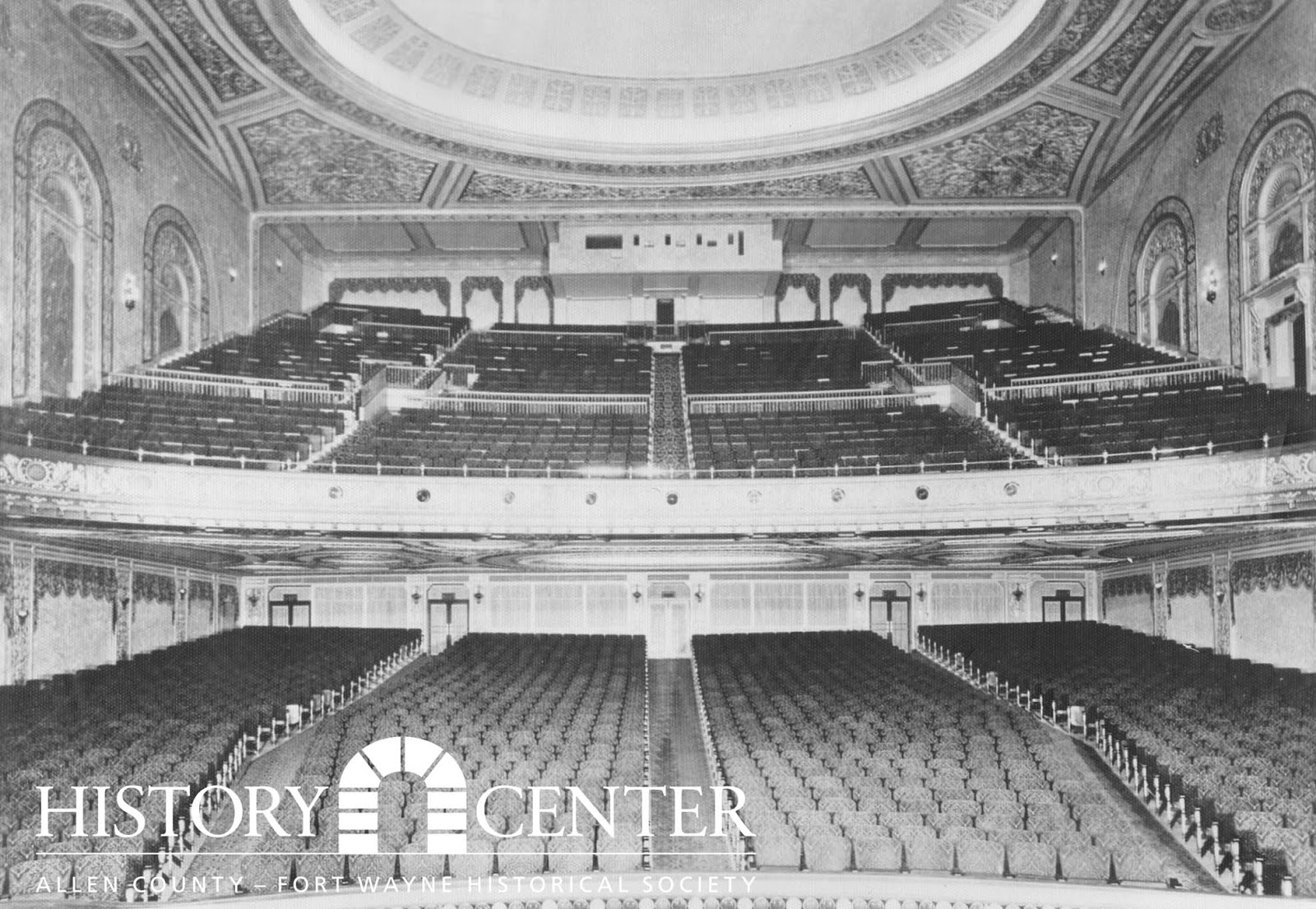
One of the places major films have been shown for decades is the magnificent movie theater still standing at 125 West Jefferson Boulevard.  The Embassy Theater is the last of the great movie and stage houses in Fort Wayne, and its restoration marks one of the city’s outstanding volunteer efforts.


Construction of the theater and the adjoining Indiana Hotel was started in 1926 and the theater opened on May 14, 1928.  Designed by Fort Wayne architect A. M. Strauss with theater architect John Eberson, the rococo interior was described by one enthusiast as, “a phantasmagoric celestial environment.”  In the lobby the visitor was delighted to be among opulent neo-mideastern arches, Romanesque barrel vaults with Wedgwood icing and grandly colored reliefs. The staircases, columns and floors were intricately marbled, and all reflected in the art deco mirrors and Corinthian lamps that lined the lobby.


The theater was originally named the Emboyd by owner Clyde Quimby in memory of his mother, Emilie Boyd.  Quimby had come to Fort Wayne after World War I and realized the growing popularity of film and the other new medium, radio.  He married Helen Kinkade, the piano player for silent movies at the Jefferson Theatre, who herself would later become a leading theater operator in Fort Wayne.  By the 1930s, Quimby owned the greatest movie houses in town: the Emboyd, the Paramount, the Jefferson and the Palace.  In 1952, the name was changed to the Embassy Theatre when the Alliance Theatre chain purchased the Emboyd.

The Emboyd was one of the first Fort Wayne buildings to be air-conditioned.  Since its first performances, the central feature of the theater has been the grand eleven hundred fifty-pipe Grande Page Organ. This instrument became the catalyst for an extraordinary volunteer restoration project.


Many entertaining greats played the theater now recorded in the late Dyne L. Pfeffenberger book relating the history of the Embassy Theatre: Red Skelton, Fats Domino, Artie Shaw, Perry Como and Bob Hope who appeared two times once in 1928 and again in 1938. As the new century has made its way into our lives, the programs continue with as much vigor as ever featuring stars such as Bill Cosby, Jerry Seinfeld, B.B. King, Ray Romano, David Copperfield and the list goes on. Among all the events, the Fort Wayne Philharmonic presents its Masterworks and Pops concerts at the Embassy each year headlining guest artists such as Melissa Manchester, Burt Bacharach, and Patti Austin. Broadway shows traveling the country also are now offered as still another attraction to the venerable ole facility.

 When it looked as if the Embassy was in peril of being saved Bob Hope said in a 1975 letter, “It saddens me to learn that the Emboyd Theatre may hit the skids. It played a big part in my earlier days when I needed food. It is a beautiful place and I remember introducing Fred Allen one time, he walked out with a wheelbarrow, took out a banjo as though he was going to play, then put it back and walked off the stage.  I hope and pray the Embassy can be saved.”

The volunteer effort to save the Embassy when it faced economic ruin began in 1974 when area organ buffs began a citywide fund-raising campaign.  This was followed by an extraordinary “hands-on” undertaking by everyday citizens to refurbish the entire building.  Today, the Embassy serves as the community’s principal concert hall for the Fort Wayne Philharmonic Orchestra and for touring theatrical productions.


The theatre received its first high quality grand piano in its over 70-year history.  Bob Goldstine, the local real estate developer and Grand Page organ player who was instrumental in sparking the volunteer effort in 1972 to save the historic theater, died in 2001.  His 1982 Yamaha C-7 concert grand was acquired for the Embassy at the Goldstine’s estate auction through the generosity of local businessman Mark Suedhoff and resides in the theater’s mezzanine-level music room, where it is played before and during intermission of most shows.

Most recently, with the coming of Harrison Square, focus has been given to the Indiana Hotel at the corner of Harrison and Jefferson streets. The seven stories of former hotel rooms wrap around the Embassy Theatre in an “L” shape. An enclosed sky bridge over Harrison connects the Harrison Square facility to the third floor of the Indiana Hotel, which has been renovated into a pedestrian corridor that links o the Jefferson Boulevard sky bridge leading to the Grand Wayne Center. 

The Embassy Theater may be the last of the great movie and stage houses in Fort Wayne, however, it can be counted among the first to continue as one of the city’s outstanding point of pride for us all.

###

Allen County Historian Tom Castaldi is author of the Wabash & Erie Canal Notebook series; hosts “On the Heritage Trail” which is broadcast Mondays on 89.1 fm WBOI; and “Historia Nostra” heard on Redeemer Radio 106.3 fm.  Enjoy his previously published columns on the History Center’s blog “Our Stories” at historycenterfw.blogspot.com.
Monday, November 2, 2015

Megan's Mystery Monday - Takaoka


Welcome back, mystery lovers! I’m back with another mystery very near and dear to our fair city of Fort Wayne. Some of you out there may be familiar with Fort Wayne’s sister city, Takaoka, Japan. I’ve been told there is a Japanese steakhouse named after it, so maybe that might be the extent of most people’s knowledge of it. 

For those who, like me, aren’t familiar with the Fort’s sister city, let’s bring in some background history. The sister city relationship between Fort Wayne and Takaoka has been in place since 1976 when a committee set out to join our two cities together during the American Bicentennial. Our two cities have remained strongly linked ever since. If you’ve ever gone to the annual Cherry Blossom Festival held at the Allen County Public Library every spring, you may have experienced some of this unity before. 

 
Buddhist Temple Bell
 
But where is the mystery, you ask? Well, back in the late 1970’s, Takaoka sent our city boxes and boxes of gifts as a symbol of our sisterhood. This collection included textiles, china, beautiful handmade metal works, cultural items, game boards, and even a long bow! It was a great gesture that we fully reciprocated and it strengthened the bonds between our two cities even more. But with such a large collection of gifts, the mayor and his sister city committee found they couldn’t feasibly store or preserve what they had been given. 


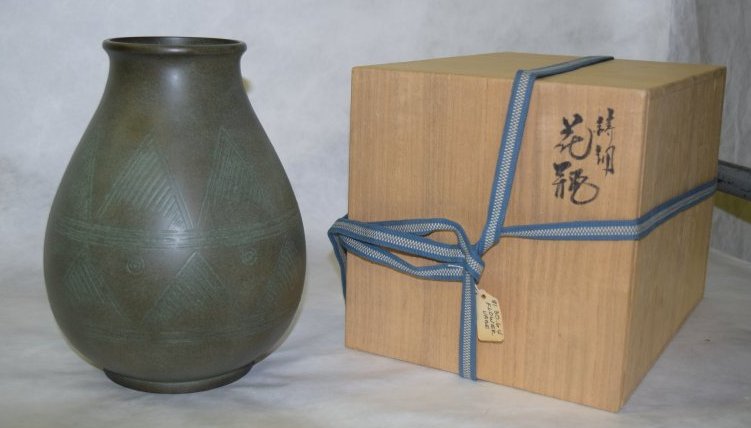
Bronze Vase and box


In steps the Allen County Fort Wayne Historical Society.

In 1981 the large collection of Japanese gifts was entrusted to us to preserve, store, and process into our system, and for the most part they were. All of the gifts were packaged up and sent to storage and then promptly forgotten about until the Botanical Conservatory asked us for help in making a sister city display for the upcoming Indiana Bicentennial.  It was then that we took stock of what we had and what would lend itself well to a display.

Japanese Wedding Treasure Ship
 
The majority of the collection hadn’t been touched or even seen for over thirty years. I was able to go over personally and help catalogue the artifacts as we uncovered them and let me tell you, it was amazing what all we found. Every single pot and vase had its own custom made wooden box, the wedding sets we found were all intricately embroidered silks, and there were even pieces of armor and war masks: the entire collection was a beautiful example of Japanese culture. 

Wedding Kimono
 
But as with most good things, there is usually a negative point that rears its ugly head. A lot of what we found had been processed and stored back in the eighties, a time when plastic wrap and scotch tape (gasp) were commonly used packing materials. This newfound attention was just what the Takaoka collection needed as we went through and repacked the artifacts using acid-free archival materials. Due to the size of the collection, this upkeep will be a long-term process, but its well on its way to breathing new life into the artifacts. 

Keep an eye out for the Botanical Conservatory’s display on our Japanese sister city and if you’d like to learn more about the history behind our relationship with Takaoka, check out this.

Until next time!